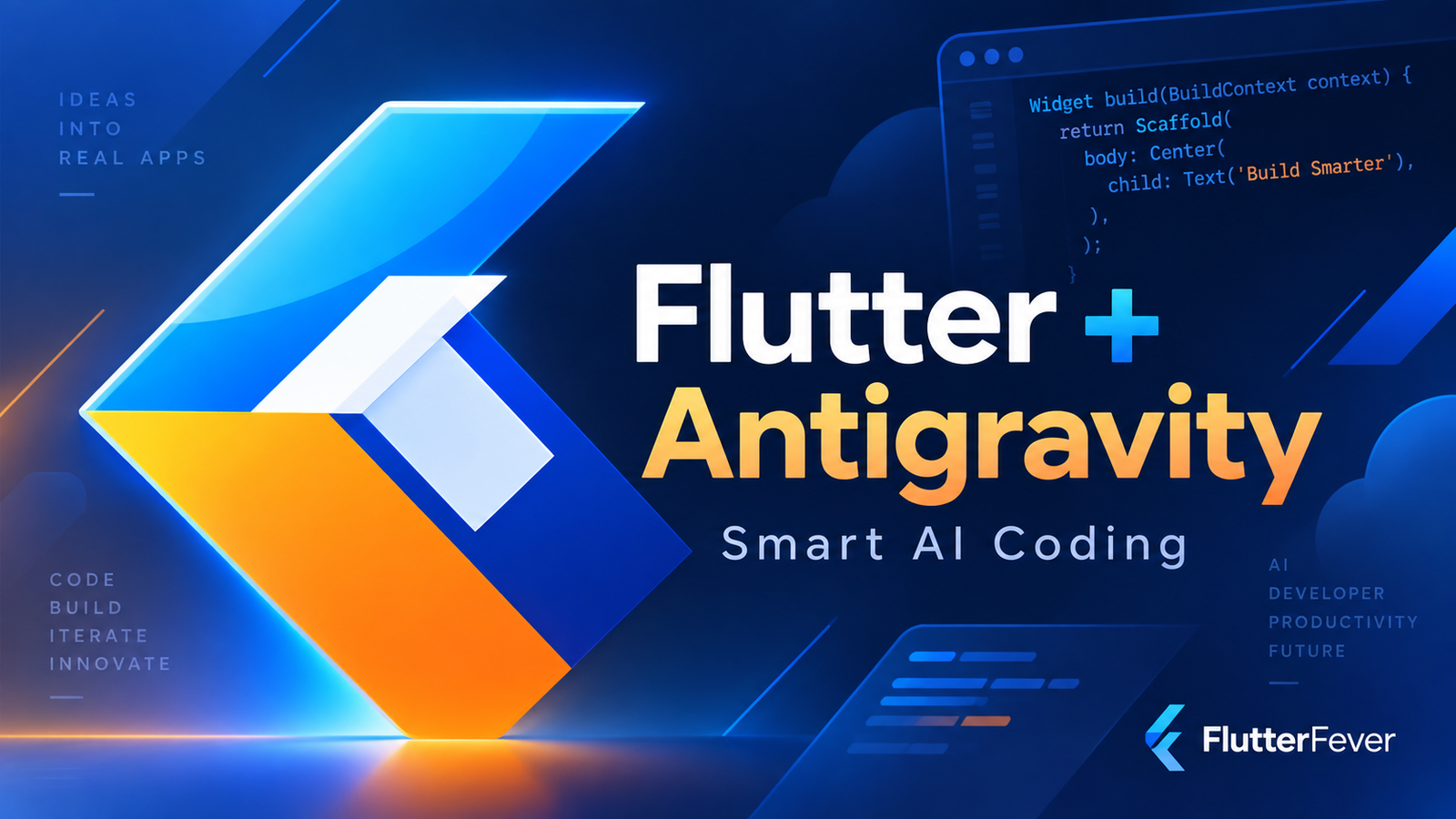
How to Code Flutter Apps Smartly with Google Antigravity
Flutter development becomes much faster when AI is used with a clear workflow instead of random prompts. Google Antigravity can help developers understand project structure, modify multiple files, run commands, debug errors, and improve productivity across a Flutter project.
What Is Google Antigravity?
Google Antigravity is an AI-powered development environment designed around coding agents. Instead of only suggesting a few lines of code, an agent can help analyze your project, work with the editor and terminal, and assist with larger development tasks.
For Flutter developers, this can be useful for creating screens, understanding architecture, fixing build problems, generating tests, reviewing code, and handling repetitive development tasks.
Start by Letting AI Understand Your Flutter Project
One of the biggest mistakes is asking AI to directly build a feature without understanding the existing codebase.
A better prompt is:
Analyze this Flutter project before making any changes.
Understand the architecture, folder structure, state management,
routing, API layer, models, repositories and existing coding patterns.
Do not modify code yet.
This reduces the risk of duplicate services, unnecessary packages, and changes that do not match your existing architecture.
Use a Simple Development Workflow
A professional Flutter + Antigravity workflow can follow this order:
- Understand the requirement
- Analyze the existing codebase
- Create an implementation plan
- Make the smallest required change
- Run static analysis and tests
- Review the Git diff
- Verify the feature manually
Give Clear Constraints
AI agents work better when you clearly define what they should not change.
Important constraints:
- Do not change existing public APIs.
- Do not replace the current state management solution.
- Do not refactor unrelated files.
- Do not add unnecessary packages.
- Preserve existing functionality.
- Keep the implementation backward compatible.
This is especially important in production Flutter applications where a small feature should not result in large architectural changes.
Use Antigravity for Flutter Debugging
Flutter build errors may involve Gradle, Android Gradle Plugin, Kotlin, Java, Android SDK, Dart packages, or Flutter plugins. Instead of randomly upgrading everything, ask the AI to identify the root cause first.
Analyze this Flutter build error.
Find the root cause first.
Check Flutter, Dart, Java, Gradle, AGP and Kotlin compatibility.
Do not upgrade unrelated dependencies.
Apply the smallest safe fix.
Always Validate AI-Generated Code
AI-generated code should never be trusted without verification. After every important change, run:
dart format .
flutter analyze
flutter test
You should also run the application on the target platform and confirm that the feature behaves correctly.
Use Git with AI Coding
Git is extremely important when using AI coding agents because the AI may modify several files very quickly.
git status
git diff
Before a large task, create a separate branch or commit the current working state. After the AI finishes, inspect every changed file before accepting the implementation.
Keep Flutter Architecture Consistent
If your project already uses Riverpod, Bloc, Provider, GetX, or another state management solution, tell the AI to follow the existing approach.
This project uses Riverpod.
Follow the existing Riverpod architecture.
Do not introduce Bloc, Provider, GetX or another state management package.
Consistency is usually more important than introducing a completely different pattern for one feature.
Avoid Hard-Coded UI Values
When AI generates Flutter UI, ask it to reuse your existing ThemeData, ColorScheme, text styles, spacing constants, and reusable widgets.
Avoid unnecessary hard-coded colors and dimensions across multiple screens because they make the application harder to maintain.
Use AI for Testing and Code Review
Antigravity can also help generate unit tests, widget tests, and integration tests. However, instead of simply asking “write tests,” define the scenarios that should be covered.
- Successful response
- Network failure
- Invalid input
- Loading state
- Error state
- Retry behavior
You can also ask the AI to review the current Git diff as a senior Flutter developer and identify architecture, performance, lifecycle, security, or null-safety problems.
Security Best Practices
Never hard-code production API keys, private tokens, passwords, or backend secrets inside a Flutter application. Mobile applications can be inspected, so sensitive credentials should normally remain on a secure backend.
AI can help with implementation, but security-sensitive code should always receive manual review.
Useful Official References
Learn more from the official Google Antigravity website .
For Flutter installation, SDK setup, APIs, testing, and development guidance, visit the official Flutter documentation .
Final Flutter + Antigravity Checklist
- Ask AI to understand the project before modifying it.
- Give clear requirements and constraints.
- Use the existing Flutter architecture.
- Avoid unnecessary dependencies and refactoring.
- Run
dart format,flutter analyze, andflutter test. - Review every Git diff.
- Test the feature manually before release.
Conclusion
Google Antigravity can make Flutter development faster and more efficient when it is used as an engineering assistant rather than a simple code generator. The best results come from combining clear prompts, existing project architecture, automated testing, Git review, and developer verification.
Smart AI-assisted Flutter development is not about asking AI to write everything. It is about using AI to understand, plan, implement, test, and review code in a controlled and professional workflow.