

How to Design Flutter Enterprise App Architecture in 2026: Scalable & AI-Ready App Systems

In 2026, Flutter enterprise app architecture is no longer just about cross-platform UI. It is about scalability, modularity, AI integration, security compliance, offline-first reliability, and long-term maintainability.
Enterprises are no longer building simple apps. They are building:
- Multi-role ecosystems (Admin, Vendor, Customer, Delivery)
- AI-integrated systems
- Real-time dashboards
- Financial & compliance modules
- Offline + sync-based rural deployments
- Microservice-connected frontends
- Web + Desktop + Mobile unified platforms
Flutter has evolved into a true enterprise-grade framework capable of powering:
- Fintech applications
- Agritech ecosystems
- Healthcare platforms
- Supply chain systems
- Hyperlocal marketplaces
- AI-powered dashboards
This article explains why Flutter enterprise app architecture matters, how to design it correctly, and what professional structure enterprises must adopt.
1. Why Flutter Enterprise App Architecture Matters in 2026
Enterprise failure is rarely due to UI problems. It fails due to:
- Poor state management
- Tight coupling between modules
- No separation of concerns
- No domain-driven structure
- Poor testing strategy
- No scaling strategy
- No API abstraction
- No caching layer
- No offline strategy
- No security layering
In 2026, architecture is your competitive advantage.
Enterprise Expectations Today
| Requirement | Why It Matters in 2026 |
|---|---|
| Scalability | Apps must handle 100K+ users |
| Modularity | Teams work in parallel |
| Clean separation | Avoid technical debt |
| Microservice compatibility | Backend is distributed |
| Offline-first | Rural & unstable network support |
| AI integration | Predictive systems embedded |
| Security | RBI / GDPR / Data compliance |
| CI/CD ready | Fast iteration cycles |
Without strong architecture, Flutter becomes a mess in months.
With strong architecture, Flutter becomes a long-term enterprise platform.
2. Core Principles of Flutter Enterprise App Architecture
1. Clean Architecture (Mandatory)
Separation of:
- Presentation Layer
- Domain Layer
- Data Layer
2. Modular Architecture
Each feature as independent module:
- Auth Module
- Order Module
- Ledger Module
- AI Module
- Analytics Module
- Notification Module
3. Domain-Driven Design (DDD)
Business logic must live in domain layer.
4. State Isolation
Use predictable state management.
Read Articles : How to Use Isolates for CPU-Intensive Tasks in Dart?
5. Dependency Injection
Loose coupling using injectable patterns.
6. Environment-Based Config
Dev / Staging / Production config separation.
3. Recommended Flutter Enterprise Architecture Structure
lib/
 ├── core/
 │    ├── network/
 │    ├── errors/
 │    ├── constants/
 │    ├── services/
 │    ├── theme/
 │    ├── utils/
 │
 ├── features/
 │    ├── auth/
 │    │    ├── data/
 │    │    ├── domain/
 │    │    ├── presentation/
 │    │
 │    ├── orders/
 │    ├── ledger/
 │    ├── analytics/
 │
 ├── shared/
 │    ├── widgets/
 │    ├── models/
 │
 ├── main_dev.dart
 ├── main_prod.dart
This is a feature-first + clean architecture hybrid model, widely adopted in 2026 enterprise projects.
4. Layer-by-Layer Deep Explanation
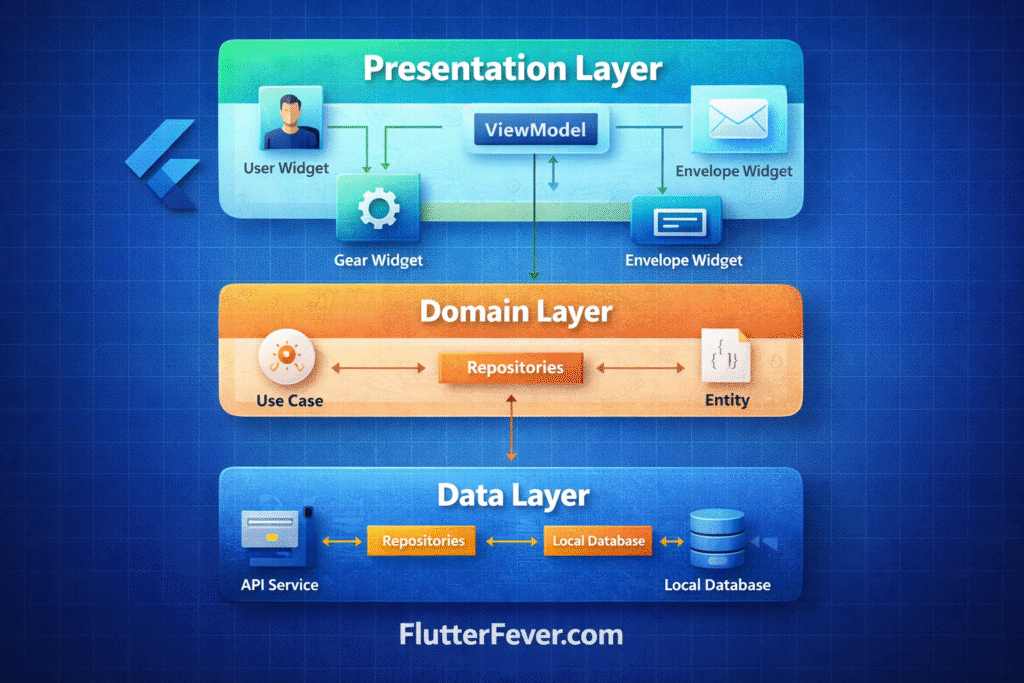
4.1 Presentation Layer
Responsible for:
- UI
- State management
- UI logic
- Controllers
- ViewModels
Recommended tools (2026):
- Riverpod (preferred)
- Bloc (still used)
- GetX (for fast systems)
- Cubit for lightweight modules
Read Articles: How to Use Riverpod in Flutter Full tutorials
Why Riverpod is Dominating in 2026?
- Compile-time safety
- Test-friendly
- No BuildContext dependency
- Scalable state control
Read Articles : How to Use Riverpod in Flutter with Full Example
4.2 Domain Layer (Heart of Enterprise System)
Contains:
- Entities
- Use cases
- Repository contracts
- Business rules
Example:
class CreateOrderUseCase {
  final OrderRepository repository;
  CreateOrderUseCase(this.repository);  Future<Order> call(OrderParams params) {
    return repository.createOrder(params);
  }
}
This layer does NOT depend on Flutter.
This makes:
- Testing easier
- Backend change resistant
- Business logic stable
4.3 Data Layer
Responsible for:
- API calls
- Database
- Cache
- Models
- Repository implementation
Example:
- REST
- GraphQL
- gRPC
- Firebase
- Supabase
- Custom backend
5. State Management Strategy in Enterprise Flutter
| App Type | Recommended State |
|---|---|
| Fintech | Riverpod + StateNotifier |
| Marketplace | Riverpod + Freezed |
| AI dashboard | Bloc + Stream |
| Admin panel | Riverpod |
| POS System | GetX (performance-focused) |
Never mix state management randomly.
Enterprise rule: One architecture, one state approach.
6. API Architecture in Enterprise Flutter
Standard
- Repository pattern
- Dio or HttpClient abstraction
- Interceptors for:
- Token refresh
- Logging
- Retry
- Encryption
Example layers:
API Service → Repository → UseCase → Controller → UI
7. Offline-First Architecture
Especially critical for:
- Rural systems
- Logistics
- Agriculture
- Retail POS
Required Layers
| Component | Role |
|---|---|
| Local DB (Isar / Hive / Drift) | Store data |
| Sync Engine | Background sync |
| Conflict Resolver | Handle merge conflicts |
| Queue Manager | Retry failed APIs |
Without offline-first design, enterprise apps fail in unstable networks.
8. Security Architecture in Flutter Enterprise Apps
in 2026, security is not optional.
Mandatory Layers
- Encrypted storage
- SSL pinning
- Token auto-refresh
- Role-based UI rendering
- Secure API headers
- Data masking
- Audit logging
Example:
SecureStorage → TokenManager → APIInterceptor → RoleGuard → UI
9. AI Integration Layer in 2026 Enterprise Apps
Modern Flutter enterprise apps include:
- Recommendation engines
- Smart search
- Prediction models
- Chat assistants
- Computer vision
Architecture must include:
AI Service Layer
 → Local inference (on-device models)
 → Remote inference (API)
 → Fallback system
Do NOT tightly couple AI logic inside UI.
10. CI/CD & DevOps Structure
Enterprise Flutter must support:
- Fastlane
- Codemagic
- GitHub Actions
- Environment-based builds
- Feature flags
- OTA update strategy
11. Performance Optimization Strategy
| Area | Strategy |
|---|---|
| Rebuilds | Selective listening |
| Images | CachedNetworkImage |
| Lists | Lazy loading |
| Large datasets | Pagination |
| Memory | Dispose controllers |
| Background tasks | Isolates |
12. Pros of Flutter Enterprise Architecture
| Advantage | Why Important |
|---|---|
| Single codebase | Cost reduction |
| Multi-platform | Mobile + Web + Desktop |
| Faster iteration | Dev velocity |
| UI consistency | Brand alignment |
| Strong ecosystem | Package maturity |
| AI-ready | ML integration support |
13. Cons & Challenges
| Challenge | Solution |
|---|---|
| Architecture complexity | Follow clean template |
| Team onboarding | Proper documentation |
| Plugin instability | Maintain abstraction layer |
| Web performance | Optimize rendering strategy |
| Large app size | Modularize & lazy load |
14. Common Architecture Mistakes (Avoid These)
- Business logic inside UI
- No repository abstraction
- No error handling layer
- No centralized network layer
- No logging
- No role-based rendering
- No environment separation
- Mixing GetX + Bloc randomly
Read Articles : Flutter GetX: Complete Guide to State Management, Navigation, Dependency Injection, and Performance
These kill enterprise scalability.
15. Final Enterprise Architecture Blueprint
UI Layer
   ↓
State Controller
   ↓
Use Case (Domain)
   ↓
Repository Interface
   ↓
Data Source (Remote + Local)
   ↓
Core Services (Network / Cache / Security)
This is the modern Flutter enterprise app architecture standard in 2026.
Conclusion
Flutter in 2026 is no longer just a mobile UI framework.
It is:
- A multi-platform enterprise engine
- AI-ready application framework
- Fintech-compatible system
- Offline-first scalable architecture base
- Clean-architecture-friendly environment
If you design architecture correctly:
Your Flutter app will scale from 1,000 to 1,000,000 users.
Read : Flutter App Architecture in the AI Era: Why Code Generation Isn’t Enough
FAQ – Flutter Enterprise Architecture
Flutter enterprise architecture in 2026 refers to a structured, scalable, and modular application design approach that separates presentation, domain, and data layers using clean architecture principles.
It enables:
High scalability (100K+ users)
Microservice integration
AI-ready modules
Offline-first capability
Secure enterprise deployment
Unlike small apps, enterprise Flutter architecture focuses on long-term maintainability and team collaboration.
To design a scalable Flutter app architecture, follow these steps:
Use feature-based modular structure.
Apply repository pattern.
Separate use cases from UI.
Implement proper state management (Riverpod or Bloc).
Add caching and offline sync.
Use environment-based configuration.
Scalability is not about UI — it’s about structured layering.
Yes. Modern Flutter enterprise architecture integrates seamlessly with:
REST APIs
GraphQL
gRPC
Firebase
Supabase
Custom microservices backends
Using a repository + data source pattern ensures smooth communication between Flutter frontend and distributed backend systems.
For enterprise-level applications:
Riverpod → Most scalable & testable
Bloc → Strong event-driven systems
Cubit → Lightweight modules
GetX → Performance-focused POS systems
In enterprise Flutter architecture, consistency matters more than popularity.
A properly designed secure Flutter enterprise app includes:
Encrypted local storage
SSL pinning
Token auto-refresh
Role-based access control
Secure API interceptors
Audit logs
Security depends on architecture discipline, not just Flutter framework.
Modern AI-ready Flutter apps include:
Recommendation engines
Smart search
Predictive analytics
Chat assistants
On-device ML inference
AI logic should exist as a separate service layer — not inside UI controllers.
Yes.
Flutter in 2026 supports:
Multi-platform deployment (Mobile, Web, Desktop)
High-performance rendering
Modular architecture
CI/CD integration
Microservice backend systems
AI integration
When designed correctly, Flutter enterprise architecture can scale to millions of users.