

Flutter Developer Roadmap 2026: Complete Skill Path, Career Scope, and Future Trends

Flutter has crossed the phase of being “just another cross-platform framework.”
By 2026, Flutter sits at the intersection of product engineering, enterprise software, multi-platform delivery, and emerging AI-driven experiences.
This article is written for developers who are not asking “How do I learn Flutter?”
but rather:
- What skills will keep me relevant in 2026 and beyond?
- Where does Flutter fit in the global software job market?
- What separates an average Flutter developer from a high-value professional?
1. Flutter’s Position in the Global Software Landscape (2026 Perspective)
By 2026, the global software industry is shaped by three dominant forces:
- Cost-efficient cross-platform development
- Faster product iteration cycles
- Smaller, highly skilled engineering teams
Flutter aligns strongly with all three.
Organizations increasingly prefer:
- a single codebase
- predictable UI behavior
- faster hiring and onboarding
- shared design systems across platforms
This makes Flutter particularly attractive for:
- SaaS companies
- fintech platforms
- internal enterprise tools
- startups targeting global markets
Flutter’s relevance in 2026 is not about hype; it is about economic efficiency and engineering pragmatism.
2. What “Flutter Developer” Really Means in 2026
The definition of a Flutter developer has evolved.
Outdated definition
“Someone who builds mobile UIs in Flutter.”
2026 definition
“A cross-platform product engineer who understands UI systems, state flow, backend interaction, performance trade-offs, and long-term maintainability.”
This shift is critical.
Flutter developers are now expected to think in terms of:
- systems, not screens
- architecture, not widgets
- product lifecycle, not just features
3. Flutter Skill Path 2026: A Professional Progression Model
A research-oriented roadmap does not list tools randomly.
It organizes skills by engineering maturity.
Stage 1: Core Language and Framework Mastery
This stage is not optional, but it is also not the end goal.
Professional expectations include:
- deep understanding of Dart’s type system and null safety
- widget lifecycle awareness
- composition over inheritance
- layout behavior across different screen constraints
At this stage, the focus is not speed — it is correctness and predictability.
Stage 2: State, Data Flow, and UI Consistency
In real-world Flutter projects, state management is not a library choice — it is a design decision.
By 2026, professional Flutter developers are expected to:
- reason about state boundaries
- manage asynchronous data predictably
- avoid tightly coupled UI logic
- design for testability
The market rewards developers who can explain why a state strategy was chosen, not just how it works.
This stage defines whether a developer can handle:
- growing codebases
- multiple contributors
- long-lived products
Stage 3: Backend Awareness and Data Integration
Flutter developers who remain UI-only face stagnation.
In 2026, valuable Flutter professionals:
- understand REST and event-driven APIs
- know authentication and authorization flows
- handle failure scenarios gracefully
- design offline-aware and resilient apps
This does not require becoming a backend engineer, but it does require:
- architectural literacy
- system thinking
- security awareness
Flutter developers with backend fluency consistently command higher responsibility and compensation.
Stage 4: Architecture, Scalability, and Maintainability
This is where developers move from contributors to decision-makers.
Professional Flutter engineers are expected to:
- design modular codebases
- separate domain logic from presentation
- reduce long-term technical debt
- support team scalability
Architecture in 2026 is less about rigid patterns and more about:
- clarity
- ownership
- evolution over time
This stage is critical for leadership roles.
Stage 5: Performance Engineering and Quality Assurance
As Flutter apps scale across platforms, performance becomes a business issue, not a technical luxury.
Professionals in 2026 must:
- understand rendering costs
- profile memory and frame performance
- optimize build size and startup time
- write meaningful automated tests
Organizations increasingly reject apps that are visually rich but operationally fragile.
Stage 6: Multi-Platform and Enterprise Expansion
Flutter’s role has expanded beyond consumer mobile apps.
By 2026, high-value Flutter developers work on:
- web dashboards
- desktop productivity tools
- internal enterprise systems
- embedded or device-specific UIs
This stage has lower competition and higher strategic importance.
Stage 7: Future-Facing and Differentiation Skills
This is where Flutter careers become future-proof.
Emerging areas include:
- AI-assisted user experiences
- offline-first architectures
- edge and device-level intelligence
- domain-specific applications (fintech, health, agri-tech, logistics)
Developers operating here are no longer interchangeable resources — they become domain experts.
4. Career Scope of Flutter Developers in 2026 Global Job Market Trends
- Increasing demand for cross-platform engineers
- Rising remote and distributed teams
- Preference for engineers who own features end-to-end
Career Roles Flutter Developers Can Grow Into
- Product Engineer
- Senior Mobile Engineer
- Cross-Platform Architect
- Tech Lead
- Startup Engineering Generalist
Flutter acts as a career multiplier when combined with architectural thinking and domain expertise.
5. Common Career Mistakes Flutter Developers Must Avoid
Research shows stagnation happens when developers:
- chase packages instead of principles
- avoid architectural responsibility
- ignore backend and system design
- focus only on UI polish
- stop learning after “getting a job”
Flutter rewards depth, not noise.
6. Future Trends Shaping Flutter Development
Looking ahead, Flutter’s trajectory is influenced by:
- enterprise adoption
- integration with AI workflows
- demand for offline-capable apps
- convergence of web, mobile, and desktop tooling
Flutter developers who align with these trends will remain relevant even as tools evolve.
7. Final Perspective: Flutter as a Long-Term Career Choice
Flutter is not a shortcut career.
It is a platform for engineers who think holistically.
In 2026 and beyond, the most successful Flutter developers are not those who know the most APIs — but those who understand:
- systems
- trade-offs
- long-term product health
- business impact of technical decisions
If approached professionally, Flutter offers:
- stability
- global opportunity
- leadership growth
- long-term relevance
Flutter has matured into a strategic technology rather than a tactical choice.
By 2026, Flutter is no longer evaluated only as a “mobile framework” but as a cross-platform engineering ecosystem supporting business efficiency, faster delivery cycles, and lean engineering teams.
- Regional demand analysis (Europe, Asia, Western markets)
- Industry-driven future predictions
- Career-oriented insights grounded in hiring and market behavior
It is written for developers who think in years, not tutorials.
1. Global Demand Landscape for Flutter Developers (2026)
Flutter demand does not look the same everywhere.
Understanding regional hiring behavior is critical for long-term career planning.
2. Flutter Developer Demand in Europe (2026 Scenario)
Market Characteristics
European tech markets are shaped by:
- strong regulations (GDPR, accessibility laws)
- preference for long-term maintainable software
- cost-controlled engineering teams
- emphasis on code quality and testing
Flutter’s Role in Europe
Flutter adoption in Europe is strongest in:
- fintech
- e-governance platforms
- healthcare systems
- enterprise internal tools
- logistics and mobility startups
European companies value Flutter because:
- one codebase reduces compliance overhead
- UI consistency improves accessibility audits
- long-term maintenance cost is lower than native stacks
Hiring Expectations in Europe
Flutter developers in Europe are expected to:
- understand architecture and testability
- work with backend teams effectively
- handle web + mobile from the same codebase
- respect performance and accessibility constraints
Career Outlook
- Demand: Stable to increasing
- Competition: Moderate
- Preference: Senior, architecture-aware developers
Flutter developers with clean architecture + backend awareness are highly favored.
3. Flutter Developer Demand in Asia (India, Southeast Asia, East Asia)
Market Characteristics
Asian markets are defined by:
- rapid startup growth
- cost-sensitive product development
- massive mobile-first user bases
- fast iteration cycles
Flutter’s Role in Asia
Flutter is widely adopted for:
- consumer apps
- fintech and payments
- logistics and delivery platforms
- agritech and edtech
- super-app ecosystems
Asia is currently the largest talent supply region for Flutter developers.
Hiring Reality
Two parallel markets exist:
- High-volume, low-depth Flutter roles
- High-skill, global-facing Flutter engineers
The gap between these two is widening.
Career Outlook
- Demand: Very high
- Competition: High at entry level
- Opportunity: Strong for skilled professionals
Flutter developers who remain UI-only face saturation.
Those who add architecture, backend, and system thinking gain global mobility.
4. Flutter Developer Demand in Western Countries (USA, Canada, Australia)
Market Characteristics
Western tech markets prioritize:
- productivity
- speed to market
- smaller, highly skilled teams
- remote collaboration
Flutter’s Role in the West
Flutter is increasingly used for:
- SaaS dashboards
- internal tools
- B2B platforms
- MVPs that scale into full products
Companies in these regions adopt Flutter when:
- time-to-market matters more than platform purity
- engineering teams are lean
- long-term UI maintenance cost is a concern
Hiring Expectations
Western companies expect Flutter developers to:
- own features end-to-end
- collaborate with backend and product teams
- write production-quality, testable code
- understand business impact of technical choices
Career Outlook
- Demand: High but selective
- Competition: Low for senior profiles
- Pay ceiling: High for full-stack Flutter engineers
Flutter developers here are often evaluated as product engineers, not mobile specialists.
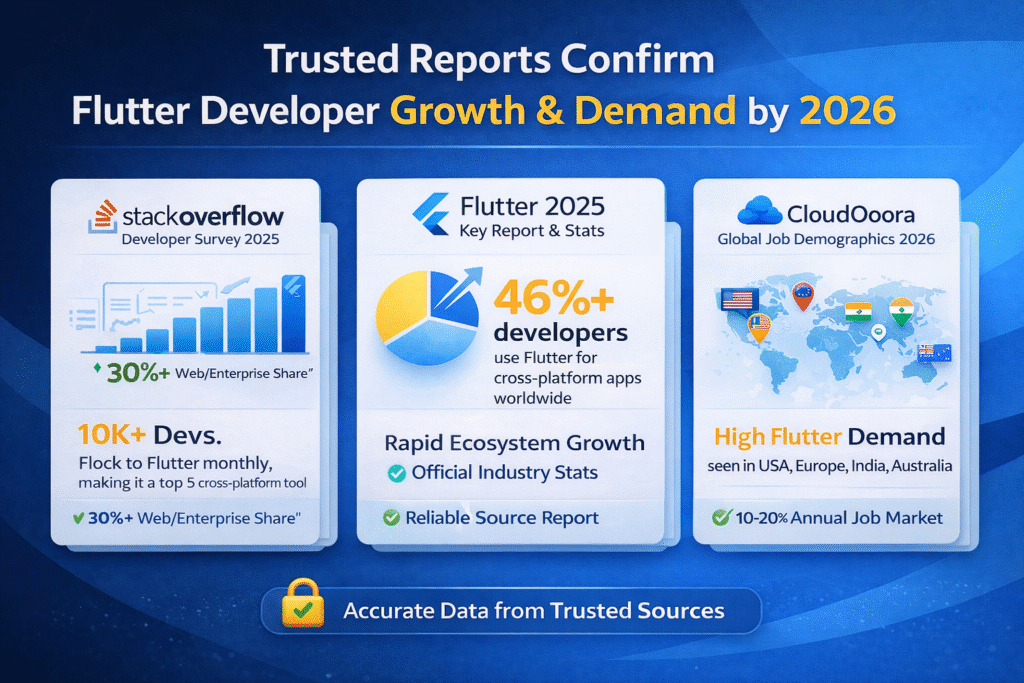
5. Comparative Regional Summary
| Region | Demand Trend | Skill Expectation | Risk Level |
|---|---|---|---|
| Europe | Stable growth | Architecture + quality | Low |
| Asia | High growth | Skills differentiate sharply | Medium |
| Western countries | Selective but premium | Full-stack & ownership | Low |
6. Future Predictions for Flutter Developers (2026–2030)
Based on current adoption and industry behavior, the following trends are highly probable:
Prediction 1: UI-Only Flutter Roles Will Decline
Flutter developers who only build screens will face:
- salary stagnation
- limited growth
- replacement by low-cost talent or tooling
Prediction 2: Flutter + Backend Will Become the Baseline
By 2026, Flutter developers are expected to:
- understand APIs deeply
- reason about data flow
- design offline-resilient apps
Prediction 3: Multi-Platform Expertise Will Outperform Mobile-Only
Flutter developers working across:
- mobile
- web
- desktop
will see lower competition and higher responsibility.
Prediction 4: Domain Knowledge Will Matter More Than Framework Knowledge
Flutter developers who specialize in:
- fintech
- healthtech
- logistics
- agritech
will command more influence than generalists.
7. Long-Term Career Stability: Is Flutter Safe?
From a strategic perspective:
- Flutter aligns with cost-efficiency
- businesses prefer fewer platforms to maintain
- cross-platform demand is rising, not shrinking
Flutter’s risk is not technological, but skill-level related.
The framework is stable.
Careers fail when developers stop evolving.
Closing Thought
Flutter in 2026 is not about knowing Flutter.
It is about thinking like an engineer who happens to use Flutter.
Developers who treat Flutter as a career foundation, not a shortcut, will find:
- global opportunities
- long-term stability
- leadership growth
The future Flutter developer is not a framework expert —
they are a cross-platform product engineer.
Frequently Asked Questions
Both, but enterprises expect stronger architecture discipline.
Yes, if they demonstrate system-level thinking and ownership.
Yes, when built with maintainability and testing in mind.
No. It complements native development by reducing cost and complexity.
Yes. It is no longer optional for career growth.
Yes, especially for dashboards, admin panels, and internal tools.
Architecture ownership, performance awareness, and system thinking.