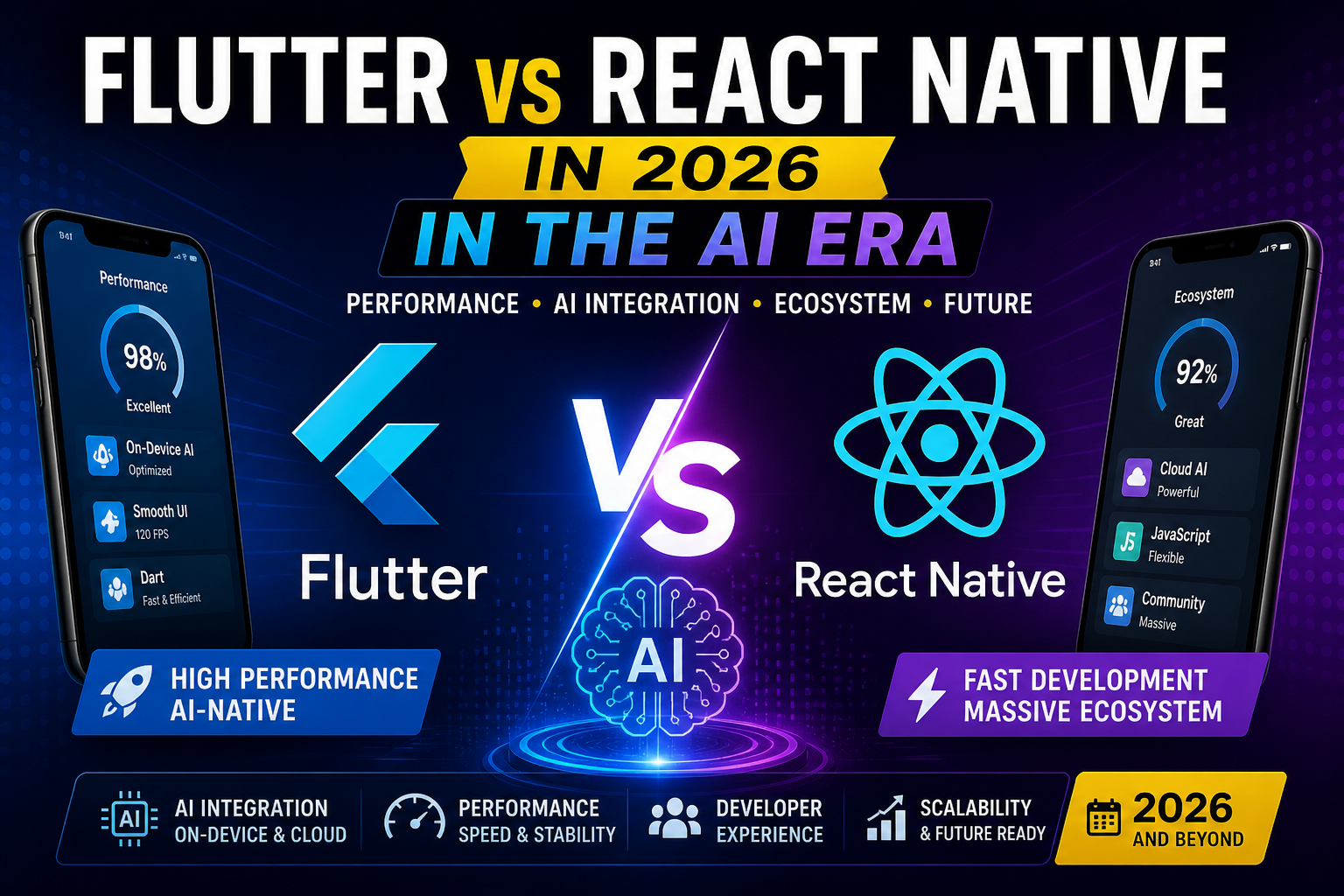
The mobile app development landscape in 2026 is no longer defined solely by performance benchmarks or UI capabilities—it is now fundamentally shaped by the integration of artificial intelligence into every layer of the application stack. From predictive user interfaces and personalized experiences to real-time decision engines and on-device machine learning, modern applications are expected to be intelligent, adaptive, and context-aware. In this transformed environment, the choice of development framework becomes critically strategic rather than merely technical.
Two dominant cross-platform frameworks—Flutter and React Native—continue to lead the ecosystem. However, their evolution in the AI era has diverged significantly, reflecting different philosophies in architecture, performance optimization, and developer workflows. Flutter, backed by Google, emphasizes a tightly controlled rendering engine and deep integration with native performance layers, while React Native, supported by Meta, leans into its JavaScript ecosystem and flexible integration with web technologies.
This article provides a comprehensive, deeply analytical comparison of Flutter vs React Native in 2026, examining their capabilities through the lens of AI integration, performance engineering, scalability, developer experience, ecosystem maturity, and long-term viability.
1. Framework Evolution in the AI Era
Flutter’s Evolution
Flutter has matured into a highly optimized UI toolkit powered by the Dart language and the Skia rendering engine. By 2026, Flutter has significantly strengthened its capabilities in:
- On-device AI inference support
- GPU-accelerated rendering pipelines
- Seamless integration with edge AI models
- Consistent UI rendering across platforms
Flutter’s architecture eliminates reliance on native UI components, enabling precise control over rendering—an advantage when building AI-driven interfaces that require real-time updates and animations.
Read : What is Flutter SDK? Complete Guide, Uses, Future Scope, and Comparison (2026)
React Native’s Evolution
React Native has evolved through:
- The introduction of the Fabric architecture
- Improved JavaScript-to-native bridge efficiency
- Stronger TypeScript adoption
- Deep integration with AI libraries in the JavaScript ecosystem
2. Core Architectural Differences
| Feature | Flutter | React Native |
|---|---|---|
| Language | Dart | JavaScript / TypeScript |
| Rendering | Custom (Skia Engine) | Native Components |
| Performance Layer | Direct native compilation | Bridge-based (improved in Fabric) |
| UI Consistency | High (same across platforms) | Medium (depends on platform UI) |
| AI Integration | Strong (on-device optimized) | Strong (cloud + JS ecosystem) |
Flutter’s architecture provides tighter control, while React Native offers greater flexibility.
3. Performance in AI-Driven Applications
In 2026, performance is no longer just about speed—it’s about real-time intelligence.
Flutter Performance
Flutter excels in:
- High frame rate rendering (60–120 FPS)
- Complex animations
- AI-driven UI updates
- Low latency interactions
Its compiled nature ensures predictable performance, especially for AI-heavy applications such as:
- Real-time dashboards
- Computer vision apps
- AR interfaces
React Native Performance
React Native performs well in:
- Standard applications
- Content-driven apps
- API-based AI integrations
However, in extremely high-performance scenarios, it may still require native modules.
4. AI Integration Capabilities
| AI Capability | Flutter | React Native |
|---|---|---|
| On-device ML | Excellent | Moderate |
| TensorFlow Lite Support | Strong | Limited |
| Cloud AI APIs | Strong | Very Strong |
| Real-time Processing | High | Medium |
| Edge AI | Advanced | Growing |
Flutter leads in edge AI and on-device processing, while React Native dominates cloud-based AI integrations.
5. Developer Experience in 2026
Flutter
- Strong tooling (Flutter DevTools)
- Fast hot reload
- Structured ecosystem
- Better for large teams
Read : Flutter Performance Optimization in 2026: The Complete Guide to Building High-Performance Apps
React Native
- Massive community
- Easier onboarding (JavaScript)
- Flexible architecture
- Faster MVP development
6. UI/UX Capabilities in Intelligent Apps
Flutter provides:
- Pixel-perfect UI
- Custom animations
- AI-driven dynamic interfaces
React Native offers:
- Native feel
- Platform-specific UI advantages
- Faster UI integration with web systems
7. Scalability and Enterprise Readiness
| Factor | Flutter | React Native |
|---|---|---|
| Large-scale apps | Excellent | Very Good |
| Code maintainability | High | Medium |
| Team scalability | High | High |
| Long-term stability | Strong | Strong |
8. Ecosystem and Community
React Native still leads in sheer ecosystem size due to JavaScript’s dominance, but Flutter has rapidly grown into a robust and stable ecosystem.
9. Use Case Analysis
Choose Flutter if:
- You need high-performance apps
- AI runs on-device
- UI consistency is critical
- You’re building super apps
Choose React Native if:
- You have a JavaScript team
- You want faster development
- Your app relies heavily on APIs
- You need web + mobile synergy
You want faster development Your app relies heavily on APIs You need web + mobile synergy You have a JavaScript team
10. AI Era Use Cases
| Use Case | Best Framework |
|---|---|
| AI-powered marketplace | Flutter |
| Social media app | React Native |
| Real-time analytics dashboard | Flutter |
| SaaS mobile apps | React Native |
| Agri-tech AI app (like Farmitra) | Flutter |
11. Future Outlook (2026–2030)
The next five years will be defined by:
- Edge AI dominance
- Offline-first intelligent apps
- Hyper-personalization
- Voice-first interfaces
Flutter is likely to dominate performance-heavy AI applications, while React Native will continue thriving in rapid deployment ecosystems.
Read : Flutter vs Other Frameworks: Complete In-Depth Comparison Guide for 2026
12. Final Verdict
Flutter and React Native are not competitors in the traditional sense anymore—they are tools optimized for different paradigms.
- Flutter = Performance + Control + AI-native architecture
- React Native = Flexibility + Speed + Ecosystem power
Conclusion
In the AI era of 2026, the decision between Flutter and React Native should be guided by the nature of intelligence your application requires. If your vision includes real-time processing, edge AI, and deeply customized UI experiences, Flutter stands out as the superior choice. However, if your focus is on rapid scalability, integration with web ecosystems, and leveraging existing JavaScript expertise, React Native remains a powerful and practical solution.
The future belongs to intelligent applications—and choosing the right framework is the first step toward building them.
Read : Flutter App Architecture in the AI Era: Why Code Generation Isn’t Enough
FAQs: Flutter vs React Native in 2026 (AI Era)
Flutter uses its own rendering engine (Impeller) for UI, ensuring consistency across platforms, while React Native relies on native components. This makes Flutter more predictable, whereas React Native offers more flexibility.
Flutter is generally better for on-device AI and real-time processing due to its performance advantages. React Native is strong for cloud-based AI integrations using JavaScript ecosystems.
Yes, in most performance-critical scenarios, Flutter is faster because it compiles directly to native code. React Native may require optimization or native modules for similar performance.
React Native is easier for developers familiar with JavaScript. Flutter requires learning Dart, but its structured approach makes it easier to master for large-scale projects.
Yes, both frameworks are mature and widely used for production apps. Companies across industries rely on both for scalable and reliable mobile applications.
React Native is often preferred for startups due to faster development and a large talent pool. Flutter is ideal when performance and UI consistency are critical from the start.
Yes, Flutter supports web and desktop along with mobile. React Native also supports these platforms but often requires additional tools and configurations.
Choose Flutter for performance-heavy, AI-driven apps with complex UI needs. Choose React Native for faster development, web integration, and projects leveraging JavaScript expertise.