The world of cross-platform app development has changed rapidly over the last few years. In 2026, businesses, startups, and enterprise companies are increasingly searching for faster development cycles, lower maintenance costs, and better user experiences across Android, iOS, web, desktop, and even embedded platforms.
Two technologies dominate this discussion today: Flutter and Kotlin Multiplatform.
If you are planning to build a mobile app in 2026, choosing between Flutter and Kotlin Multiplatform (KMP) can directly impact your project’s performance, scalability, UI quality, developer productivity, hiring cost, and long-term maintenance.
In this complete guide, we will compare Flutter vs Kotlin Multiplatform in 2026 based on:
- Performance
- UI development
- Learning curve
- Developer experience
- Community support
- Backend integration
- Scalability
- Enterprise adoption
- AI integration
- Web and desktop support
- App size
- Future roadmap
- Real-world use cases
By the end of this article, you will clearly understand which cross-platform framework is best for your next project.
What is Flutter?
Flutter is Google’s open-source UI toolkit for building cross-platform applications from a single codebase.
Flutter uses the Dart programming language and provides its own rendering engine, widgets, and UI framework. Developers can create highly customized and visually attractive applications for:
- Android
- iOS
- Web
- Windows
- macOS
- Linux
Flutter became extremely popular because of:
- Fast development
- Hot reload
- Beautiful UI
- Strong community support
- Excellent startup ecosystem adoption
In 2026, Flutter remains one of the most popular cross-platform frameworks worldwide.
What is Kotlin Multiplatform?
Kotlin Multiplatform (KMP) is JetBrains’ cross-platform technology that allows developers to share business logic across multiple platforms while keeping native UI development.
Unlike Flutter, Kotlin Multiplatform does not replace native UI completely. Instead, it focuses on code sharing for:
- Networking
- API handling
- Business logic
- Database layer
- Authentication
- State management
- Domain models
KMP works seamlessly with:
- Android native apps
- SwiftUI on iOS
- Compose Multiplatform
- Backend services
In 2026, Kotlin Multiplatform is growing rapidly among enterprise companies because it allows teams to maintain native experiences while reducing duplicate code.
Flutter vs Kotlin Multiplatform in 2026
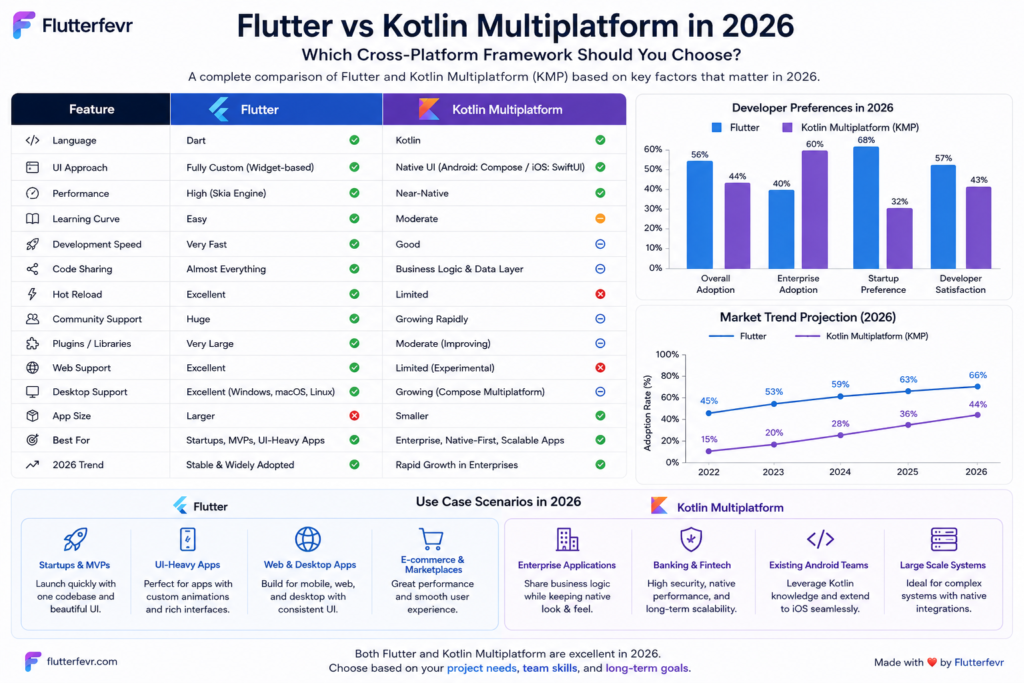
Quick Comparison Table
| Feature | Flutter | Kotlin Multiplatform |
|---|---|---|
| Language | Dart | Kotlin |
| UI Approach | Fully custom UI | Native UI |
| Performance | Very high | Near-native |
| iOS Integration | Good | Excellent |
| Android Integration | Excellent | Native |
| Web Support | Strong | Limited |
| Desktop Support | Excellent | Growing |
| Learning Curve | Easy | Moderate |
| Community | Huge | Rapidly growing |
| Enterprise Adoption | High | Very high in enterprise |
| Hot Reload | Excellent | Limited |
| Shared Code | Almost everything | Mostly business logic |
| App Size | Larger | Smaller |
| Native Feel | Custom rendering | Fully native |
| Best For | Startups, MVPs, UI-heavy apps | Enterprise and native-focused apps |
Flutter vs Kotlin Multiplatform Performance in 2026
Performance remains one of the biggest deciding factors in cross-platform app development.
Flutter Performance
Flutter uses its own rendering engine called Skia. Because Flutter controls every pixel on the screen, animations and transitions are extremely smooth.
Advantages of Flutter performance:
- 60 FPS and 120 FPS animations
- Fast rendering
- Excellent GPU acceleration
- Consistent UI across platforms
- Smooth custom animations
Flutter performs exceptionally well in:
- E-commerce apps
- Delivery apps
- Social media apps
- Dashboard apps
- Fintech applications
However, Flutter apps can sometimes consume more memory compared to fully native apps.
Kotlin Multiplatform Performance
Kotlin Multiplatform uses native UI rendering. This means:
- Android uses native Android components
- iOS uses SwiftUI/UIKit
- No custom rendering engine
Because of this approach, KMP applications feel more platform-native.
Advantages include:
- Lower memory usage
- Smaller app size
- Better OS integration
- Better battery optimization
- Native platform performance
In enterprise-grade applications, Kotlin Multiplatform often performs better for long-term scalability.
Flutter vs Kotlin Multiplatform UI Development
UI development is where the biggest difference exists between Flutter and Kotlin Multiplatform.
Flutter UI Development
Flutter provides a widget-based UI system.
Everything in Flutter is a widget:
- Buttons
- Text
- Layouts
- Animations
- Navigation
Benefits of Flutter UI:
- Pixel-perfect design
- Consistent UI across devices
- Faster UI development
- Rich animations
- Easier responsive design
Flutter is ideal for:
- Startup apps
- Custom design systems
- Highly animated apps
- Modern UI-focused applications
Kotlin Multiplatform UI Development
KMP traditionally uses native UI.
This means:
- SwiftUI for iOS
- Jetpack Compose for Android
Advantages:
- Native look and feel
- Better accessibility support
- Better platform consistency
- Easier integration with native SDKs
In 2026, Compose Multiplatform is also becoming popular and improving cross-platform UI capabilities.
However, Flutter still provides faster unified UI development compared to Kotlin Multiplatform.
Flutter vs Kotlin Multiplatform Developer Experience
Flutter Developer Experience
Flutter is known for its outstanding developer experience.
Features include:
- Hot reload
- Rich widget ecosystem
- Extensive documentation
- Large plugin library
- Fast prototyping
Flutter developers can build apps very quickly.
This makes Flutter highly suitable for:
- MVP development
- Startup products
- Rapid deployment
- Small development teams
Kotlin Multiplatform Developer Experience
Kotlin Multiplatform is improving significantly in 2026.
Advantages include:
- Reuse existing Android knowledge
- Native debugging tools
- Better backend integration
- Shared business logic
- Strong IDE support from JetBrains
However, KMP setup can still be more complex compared to Flutter.
Flutter vs Kotlin Multiplatform Learning Curve
Flutter Learning Curve
Flutter is easier for beginners because:
- Dart is simple
- Documentation is excellent
- UI system is unified
- Large tutorial ecosystem
A beginner can start building apps within days.
Kotlin Multiplatform Learning Curve
KMP requires understanding of:
- Kotlin
- Android architecture
- iOS architecture
- Native platform concepts
Because of this, Kotlin Multiplatform has a steeper learning curve.
Flutter vs Kotlin Multiplatform for Startups
For startups, development speed matters the most.
Flutter is often better for startups because:
- Single codebase
- Faster UI development
- Lower development cost
- Faster MVP launch
- Easier hiring
Many startups choose Flutter for:
- Food delivery apps
- Hyperlocal apps
- E-commerce platforms
- Social networking apps
- Logistics applications
Flutter vs Kotlin Multiplatform for Enterprise Apps
Enterprise companies increasingly prefer Kotlin Multiplatform because:
- Native UI flexibility
- Easier legacy integration
- Better scalability
- Shared business logic
- Strong Android ecosystem
Large enterprise systems often require:
- Complex native integrations
- Banking-grade security
- High-performance modules
- Deep OS-level customization
Kotlin Multiplatform performs extremely well in these scenarios.
Flutter vs Kotlin Multiplatform Community Support
Flutter Community
Flutter has:
- Millions of developers
- Huge GitHub ecosystem
- Thousands of plugins
- Massive YouTube/tutorial support
- Strong Stack Overflow presence
Flutter’s community is still larger than Kotlin Multiplatform in 2026.
Kotlin Multiplatform Community
KMP community is growing rapidly due to:
- JetBrains support
- Kotlin popularity
- Enterprise adoption
- Android ecosystem integration
Although smaller than Flutter, the KMP ecosystem is becoming stronger every year.
Flutter vs Kotlin Multiplatform Web Support
Flutter Web
Flutter web support improved significantly by 2026.
Flutter web is now used for:
- Admin panels
- SaaS dashboards
- Internal enterprise systems
- Progressive web apps
However, SEO-heavy public websites may still prefer traditional web frameworks.
Kotlin Multiplatform Web
KMP web support exists but is less mature.
Flutter clearly wins in web and desktop support.
Flutter vs Kotlin Multiplatform App Size
App size matters for emerging markets and low-storage devices.
Flutter App Size
Flutter apps are generally larger because they include:
- Rendering engine
- Framework binaries
- Dart runtime
Kotlin Multiplatform App Size
KMP apps are smaller because they rely on native platform components.
For lightweight applications, Kotlin Multiplatform has an advantage.
Flutter vs Kotlin Multiplatform AI Integration
AI-powered applications are growing rapidly in 2026.
Both Flutter and Kotlin Multiplatform support:
- OpenAI APIs
- Gemini AI APIs
- On-device AI
- Voice AI
- AI chatbots
- AI recommendation systems
Flutter provides faster UI implementation for AI applications.
Kotlin Multiplatform offers better native AI SDK integration.
When Should You Choose Flutter in 2026?
Choose Flutter if you want:
- Fast MVP development
- Beautiful custom UI
- Single codebase
- Faster development speed
- Web + desktop support
- Lower development cost
- Startup-friendly architecture
Flutter is best for:
- Delivery apps
- E-commerce apps
- Booking platforms
- Startup products
- Education apps
- Social apps
- AI-enabled mobile apps
When Should You Choose Kotlin Multiplatform in 2026?
Choose Kotlin Multiplatform if you want:
- Native UI experience
- Enterprise scalability
- Better platform integration
- Smaller app size
- Existing Android team leverage
- Shared business logic with native apps
KMP is ideal for:
- Banking apps
- Healthcare systems
- Enterprise applications
- Large-scale business systems
- Native-first ecosystems
Flutter vs Kotlin Multiplatform Future in 2026
Both technologies have strong futures.
Flutter Future
Google continues investing heavily in Flutter.
Flutter’s future strengths:
- Better web support
- AI integration
- Desktop improvements
- Better rendering performance
- Embedded systems support
Kotlin Multiplatform Future
JetBrains and Google both support Kotlin Multiplatform strongly.
KMP’s future strengths:
- Enterprise growth
- Better iOS tooling
- Compose Multiplatform maturity
- Native integration improvements
In 2026, many experts believe Kotlin Multiplatform adoption will increase significantly among enterprises.
Final Verdict: Flutter vs Kotlin Multiplatform in 2026
There is no universal winner between Flutter and Kotlin Multiplatform.
The best framework depends on your project requirements.
Choose Flutter If:
- You need rapid development
- You want one codebase
- You prioritize UI design
- You are building a startup MVP
- You need web and desktop support
Choose Kotlin Multiplatform If:
- You need native UI
- You already have Android developers
- You are building enterprise software
- You need deep native integrations
- You want long-term native scalability
In 2026, Flutter remains the best option for rapid cross-platform app development, while Kotlin Multiplatform is becoming the preferred solution for enterprise-grade native-first applications.
Both frameworks are powerful, modern, and production-ready.
The right choice depends on your business goals, team expertise, scalability requirements, and development strategy.
Frequently Asked Questions (FAQ)
Flutter is better for fast development and custom UI, while Kotlin Multiplatform is better for native integration and enterprise scalability.
Kotlin Multiplatform generally provides more native performance, but Flutter delivers smoother custom UI rendering and animations.
No. Both technologies serve different purposes and will continue growing in parallel.
Flutter is easier for beginners because of its simpler ecosystem and unified UI approach.
Yes. Flutter remains one of the best cross-platform frameworks for startups, businesses, and modern mobile app development.