

What is Flutter SDK? Complete Guide, Uses, Future Scope, and Comparison (2026)

In today’s fast-evolving digital ecosystem, the demand for high-performance, scalable, and cost-efficient application development has increased significantly. Businesses and developers are constantly searching for technologies that allow them to build applications faster without compromising on performance or user experience. This is where Flutter SDK has emerged as a transformative solution.
Flutter, developed by Google, is not just another framework but a complete software development toolkit that enables developers to create cross-platform applications using a single codebase. Whether it is mobile, web, or desktop, Flutter offers a unified development experience that simplifies complexity while maintaining high performance. As we move into 2026, Flutter continues to gain momentum, making it essential to understand its architecture, purpose, and long-term relevance.
What is Flutter SDK?
Flutter SDK, or Software Development Kit, is an open-source UI toolkit that allows developers to build natively compiled applications across multiple platforms from a single codebase. Unlike traditional frameworks that rely heavily on native components, Flutter uses its own rendering engine to draw UI elements directly onto the screen.
This unique approach gives Flutter a significant advantage in terms of performance and consistency. The SDK includes everything required for development, such as the Dart programming language, a rich set of pre-designed widgets, a high-performance rendering engine known as Skia, command-line tools, and debugging utilities.
Flutter’s architecture is designed in a way that eliminates the dependency on platform-specific UI components. Instead, it builds every pixel on the screen, which ensures that applications look and behave the same across different devices and operating systems.
History and Evolution of Flutter
Flutter’s journey began in 2015 when Google introduced an experimental project called “Sky.” The objective was to create a high-performance rendering engine capable of running smoothly at 120 frames per second. Over time, this project evolved into what we now know as Flutter.
In 2017, Flutter entered its beta phase, attracting attention from developers due to its innovative approach to UI rendering. The official stable release came in 2018 with Flutter 1.0, marking the beginning of its widespread adoption. In the following years, Flutter expanded beyond mobile development to include support for web and desktop platforms.
By 2024 and continuing into 2026, Flutter has established itself as a mainstream cross-platform development framework used by startups, enterprises, and large-scale organizations worldwide. Its continuous updates and strong backing from Google have ensured its steady growth and reliability.
Why Flutter Uses Dart
One of the defining aspects of Flutter is its use of the Dart programming language. While Dart may not have been as popular as JavaScript or Java initially, it was specifically chosen for Flutter due to its performance capabilities and developer-friendly features.
Dart supports both ahead-of-time (AOT) and just-in-time (JIT) compilation. AOT compilation converts code into native machine language before execution, which results in faster startup times and improved runtime performance. On the other hand, JIT compilation enables hot reload, a feature that allows developers to see changes instantly during development without restarting the application.
Another important reason for choosing Dart is its object-oriented nature and strong typing system, which makes code more structured, maintainable, and scalable. Additionally, Dart’s syntax is easy to learn for developers familiar with languages like Java or JavaScript, making it an efficient choice for modern development.
Read : Introduction to Dart programming Language for beginners
Why Flutter is Used
Flutter is widely used because it simplifies the development process while maintaining high performance. It allows developers to write a single codebase and deploy it across multiple platforms, significantly reducing development time and cost.
In real-world applications, Flutter is used to build mobile apps, web platforms, desktop software, and even embedded systems. It is particularly popular in industries such as e-commerce, fintech, healthcare, and agriculture, where performance and scalability are critical.
Another major reason for Flutter’s adoption is its ability to create visually appealing user interfaces. The framework provides a rich set of customizable widgets that enable developers to design modern, responsive, and consistent UI across all platforms.
Is Flutter Worth Learning in 2026?
As we analyze the current technological trends, Flutter remains one of the most valuable skills for developers in 2026. Its demand continues to grow due to the increasing need for cross-platform applications and cost-efficient development solutions.
Companies are actively hiring Flutter developers because it allows them to launch products faster while maintaining a consistent user experience. Additionally, Flutter’s ecosystem is continuously expanding, with new tools, libraries, and integrations being introduced regularly.
From a career perspective, learning Flutter in 2026 is a strategic decision. It not only opens opportunities in mobile development but also extends to web and desktop development, making it a versatile skill.
Read : Flutter Developer Roadmap 2026: Complete Skill Path, Career Scope, and Future Trends
Future Scope of Flutter
The future of Flutter is highly promising, driven by advancements in technology and increasing industry adoption. One of the key trends is its expansion beyond mobile platforms. Flutter is now being widely used for building web applications and desktop software, making it a comprehensive cross-platform solution.
Another significant development is its integration with emerging technologies such as artificial intelligence and machine learning. Flutter is increasingly being used to build intelligent applications that require real-time data processing and interactive user interfaces.
Furthermore, Flutter is gaining traction in the field of embedded systems and IoT, where lightweight and efficient UI solutions are required. With continuous improvements and strong community support, Flutter is expected to play a major role in the future of application development.
Read : Download Flutter SDK (Windows) — Also for Mac & Linux
Flutter vs Dart (Detailed Explanation)
It is important to understand that Flutter and Dart serve different purposes. Flutter is a framework used for building user interfaces, while Dart is the programming language used to write the logic behind those interfaces.
Dart acts as the foundation of Flutter, handling data processing, business logic, and application flow. Flutter, on the other hand, uses this logic to render visual components on the screen. This separation of concerns makes development more organized and efficient.
Without Dart, Flutter cannot function, as all the underlying logic and structure depend on it. Therefore, learning Dart is an essential step for anyone who wants to work with Flutter.
Read : Dart SDK vs Flutter SDK: Architecture, Differences, and How Flutter Uses Dart
Flutter vs React Native (In-Depth Analysis)
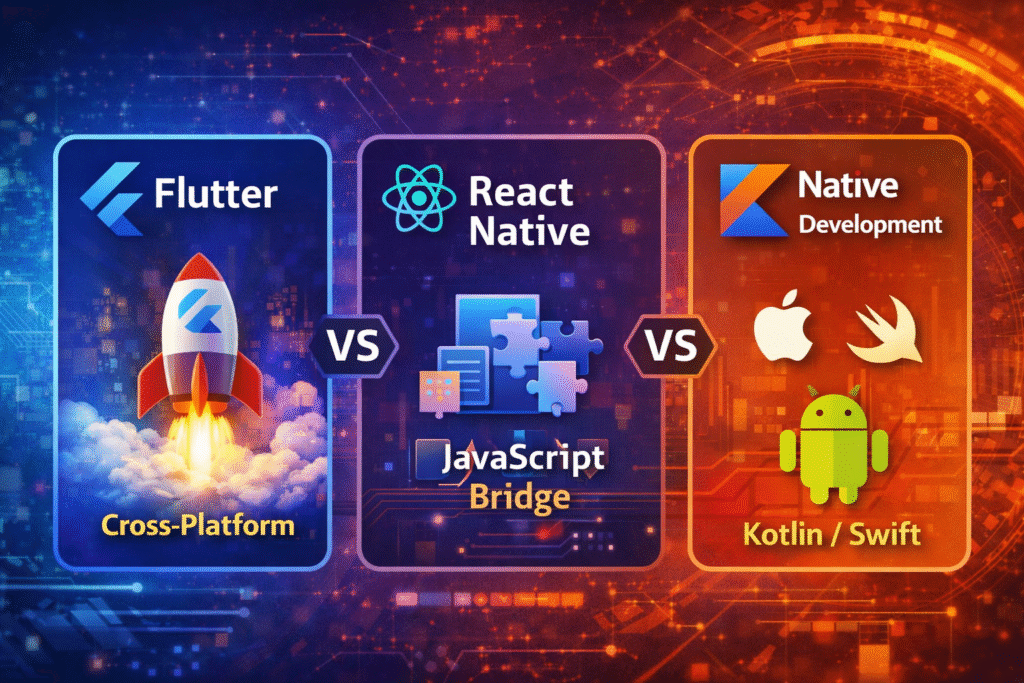
When comparing Flutter with React Native, the primary difference lies in their architecture. Flutter uses its own rendering engine to draw UI components, while React Native relies on native components connected through a JavaScript bridge.
This architectural difference has a direct impact on performance. Flutter applications generally offer smoother animations and faster execution because they do not depend on a bridge for communication. In contrast, React Native may experience performance limitations in complex applications due to the overhead of bridge communication.
In terms of UI design, Flutter provides complete control over the interface, allowing developers to create highly customized and consistent designs. React Native, however, depends on platform-specific components, which can lead to inconsistencies across different devices.
While React Native benefits from the large JavaScript ecosystem, Flutter’s growing community and strong support from Google make it a more future-proof option for modern application development.
Flutter vs Native Development (Kotlin and Swift)
Native development involves building applications separately for each platform using languages like Kotlin for Android and Swift for iOS. While this approach offers the highest level of performance and direct access to platform-specific features, it also comes with increased complexity and cost.
Flutter, on the other hand, provides near-native performance while allowing developers to maintain a single codebase. This significantly reduces development time and effort. For most applications, the performance difference between Flutter and native development is minimal and often negligible.
However, for highly specialized applications that require deep hardware integration or extremely high performance, native development may still be preferred. For the majority of use cases, Flutter offers a balanced solution that combines performance, efficiency, and scalability.
Flutter vs React Native vs Native Development (Detailed Comparison Table)
| Feature | Flutter | React Native | Native Development (Kotlin / Swift) |
|---|---|---|---|
| Type | UI Toolkit / Framework | Framework | Platform-specific Development |
| Language Used | Dart | JavaScript | Kotlin (Android), Swift (iOS) |
| Codebase | Single codebase for all platforms | Single codebase (with native modules) | Separate codebases for each platform |
| Performance | Near-native, very high | Moderate (depends on bridge) | Best (true native performance) |
| Architecture | Own rendering engine (Skia) | Uses native components via bridge | Direct platform APIs |
| UI Rendering | Fully custom UI (pixel-perfect) | Native UI components | Native UI components |
| Development Speed | Fast (Hot Reload) | Fast (JS ecosystem) | Slower (separate builds) |
| Hot Reload | Yes (very fast and stable) | Yes (but less stable) | Limited / No |
| Learning Curve | Moderate (Dart needed) | Easy (for JS developers) | Moderate to Hard |
| UI Flexibility | Very high | Medium | High (but platform-specific) |
| App Size | Larger than native | Smaller than Flutter | Smallest |
| Community Support | Growing rapidly | Very large | Very large |
| Third-party Libraries | Growing ecosystem | Very large ecosystem | Extensive |
| Maintenance Cost | Low (single codebase) | Medium | High |
| Best Use Case | Cross-platform apps, startups | JS-based apps, MVPs | High-performance apps |
| Google Support | Strong (Google-backed) | Moderate (Meta-backed) | Platform-dependent |
| Future Scope (2026) | Very strong and growing | Stable but slower growth | Always relevant |
Flutter vs Other Frameworks (Extended Table)
| Feature | Flutter | Xamarin | Ionic | Kotlin Multiplatform |
|---|---|---|---|---|
| Language | Dart | C# | HTML, CSS, JS | Kotlin |
| Performance | High | Medium | Low | High |
| UI Control | Full control | Limited | Limited | Partial |
| Code Sharing | Full (UI + Logic) | Partial | Full | Logic only |
| Best For | Modern apps | Enterprise apps | Web-based apps | Shared logic apps |
Conclusion
Flutter SDK has redefined the landscape of modern application development by offering a powerful, flexible, and efficient solution for building cross-platform applications. Its unique architecture, combined with the capabilities of the Dart programming language, enables developers to create high-performance applications with ease.
As we move further into 2026, Flutter continues to strengthen its position as a leading development framework. Its growing adoption, expanding ecosystem, and future potential make it an excellent choice for both beginners and experienced developers.
For anyone looking to build a career in software development or create scalable applications, Flutter is not just an option but a strategic investment in the future.
Read : Download Flutter SDK (Windows) — Also for Mac & Linux
FAQ
Flutter SDK is a complete software development toolkit created by Google that allows developers to build applications for Android, iOS, web, and desktop using a single codebase. It includes everything needed for development, such as the Dart programming language, UI components, and tools for testing and debugging. Its main advantage is that it enables faster development while maintaining high performance and consistent design across platforms.
In 2026, Flutter is generally considered more powerful than React Native in terms of performance and UI flexibility. Flutter uses its own rendering engine, which allows it to deliver smoother animations and consistent designs across devices. React Native, while still popular, depends on a JavaScript bridge that can create performance bottlenecks in complex applications. For modern, scalable apps, Flutter is often the preferred choice.
Yes, learning Dart is essential before working with Flutter because Flutter applications are written using Dart. However, Dart is relatively easy to learn, especially for developers who are already familiar with object-oriented programming languages like Java or JavaScript. Understanding Dart will help you write efficient and maintainable Flutter applications.
Flutter is considered one of the best frameworks for beginners due to its simple architecture, strong documentation, and fast development cycle. Features like hot reload allow beginners to instantly see changes in their code, which makes learning more interactive and efficient. Additionally, its widget-based structure makes UI development straightforward.
Flutter SDK is used for building cross-platform applications, including mobile apps, web applications, desktop software, and even embedded systems. It is widely used in industries such as e-commerce, fintech, healthcare, and agriculture due to its ability to deliver high-performance applications with a single codebase.
Flutter is a strong career option in 2026 due to its increasing demand in startups and enterprises. Companies prefer Flutter because it reduces development cost and time while maintaining quality. Developers with Flutter skills can work on multiple platforms, making them more versatile and valuable in the job market.
The future scope of Flutter is highly promising. It is expanding beyond mobile development into web, desktop, and embedded systems. Additionally, Flutter is increasingly being used in AI-powered applications and IoT solutions. With continuous support from Google and a growing developer community, Flutter is expected to remain a dominant technology in the coming years.