

Building Distributed Physical AI with Flutter: Turning Smartphones into Intelligent Vision and Sensor Nodes
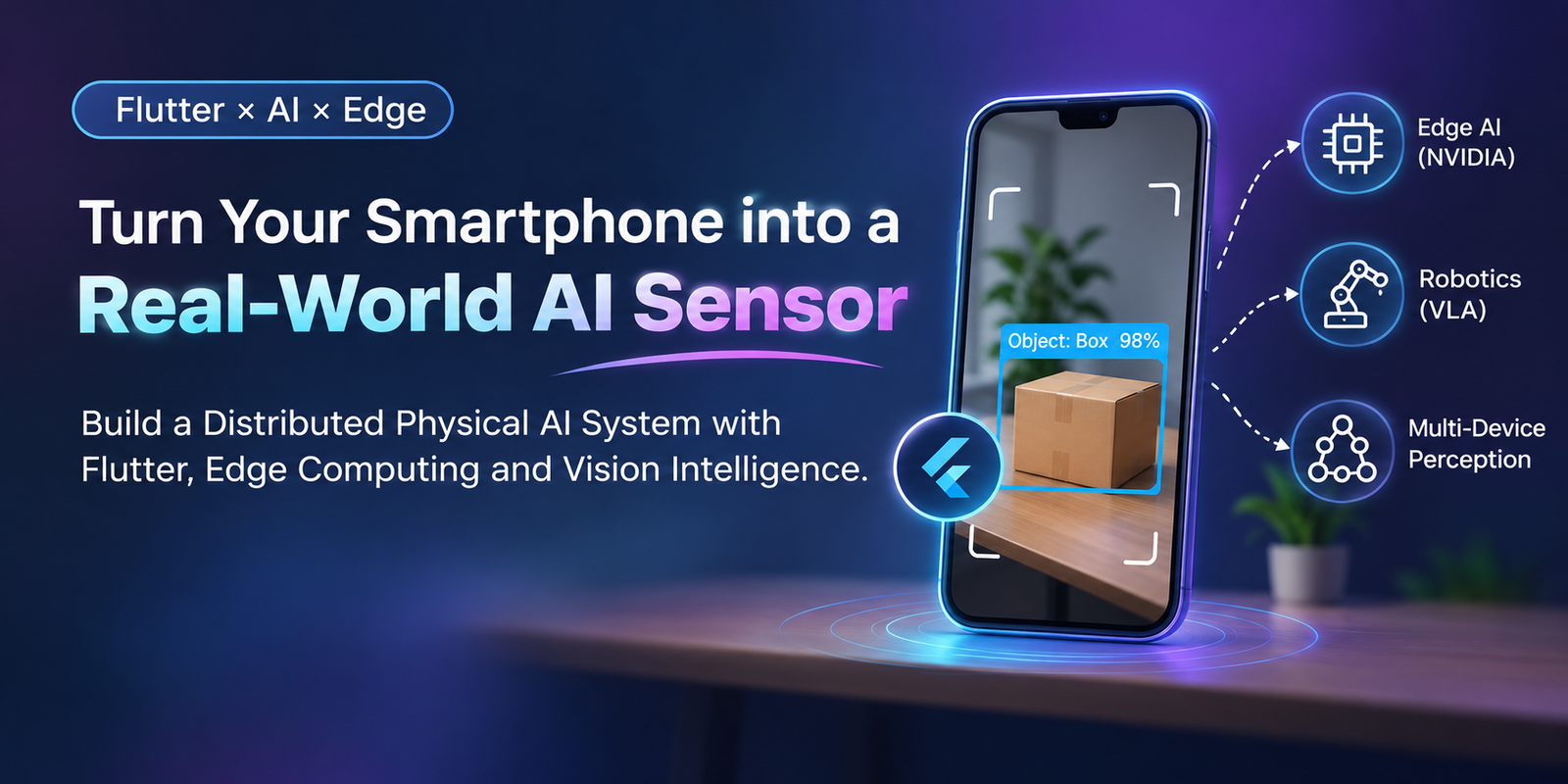
An engineering exploration of distributed perception, smartphone-based sensing, edge intelligence, NVIDIA computing, world models and the emerging role of Flutter in Physical AI systems.
Artificial intelligence is undergoing a fundamental architectural transformation. While traditional generative AI systems primarily interact with digital information, Physical AI extends machine intelligence into real-world environments through perception, contextual reasoning, prediction and physical interaction.
However, developing Physical AI systems does not necessarily require building expensive robotic hardware or deploying sophisticated sensor infrastructure from scratch.
Modern smartphones already contain high-resolution cameras, inertial measurement sensors, microphones, positioning systems, wireless communication interfaces and increasingly capable neural processing hardware.
These capabilities introduce an important research opportunity: transforming ordinary smartphones into distributed perception nodes that cooperate with nearby computing systems, intelligent devices and robotics infrastructure.
Flutter, combined with Dart, native platform APIs, edge inference runtimes and local networking protocols, could provide a practical software foundation for coordinating these heterogeneous resources.
This article presents an experimental architecture for building distributed Physical AI systems using Flutter-based smartphone nodes, GPU-enabled computing hosts, computer vision models, sensor fusion, adaptive inference offloading and emerging Vision-Language-Action models.
It also examines how existing open-source projects such as NearMitra could provide reusable connectivity infrastructure for future research and community-driven experimentation.
The architecture presented here is a proposed engineering framework rather than a completed or experimentally validated Physical AI implementation.
1. From Digital Intelligence to Physical Intelligence
For much of the recent development of artificial intelligence, the primary interaction model has involved processing digital information.
A user provides a prompt, document, image or audio recording, and an AI system generates a corresponding output.
Physical AI introduces a substantially different computational challenge.
Instead of operating exclusively on static digital inputs, Physical AI systems must interpret continuously changing environments, maintain awareness of physical conditions and potentially influence those environments through controlled actions.
A Physical AI architecture generally involves several functional stages:
- Perception of the surrounding environment.
- Representation of observed physical conditions.
- Contextual interpretation and reasoning.
- Prediction of possible future states.
- Planning of appropriate actions.
- Execution through validated physical systems.
- Continuous feedback and adaptation.
This creates a closed-loop interaction between computation and the physical world.
Physical Environment
         ↓
Sensors and Cameras
         ↓
Perception and State Estimation
         ↓
AI Reasoning and Prediction
         ↓
Action Planning
         ↓
Independent Safety Validation
         ↓
Physical Execution
         ↓
Environmental Feedback
A smartphone-based vision system may initially implement only the perception and interpretation stages.
It becomes part of a broader Physical AI system when its observations contribute to an embodied or physical-world decision loop.
For further research, NVIDIA provides an extensive ecosystem of Physical AI and Robotics Technologies, including accelerated computing, simulation and robotics foundation models.
2. The Research Opportunity Hidden Inside Modern Smartphones
A modern smartphone is frequently treated as an application endpoint.
However, from a systems-engineering perspective, it is also a compact, battery-powered sensing and communication platform.
| Smartphone Component | Potential Physical AI Contribution |
|---|---|
| RGB Camera | Object detection, scene understanding and visual inspection |
| Accelerometer | Motion and acceleration estimation |
| Gyroscope | Rotational movement estimation |
| Magnetometer | Approximate orientation information |
| Microphone | Acoustic event recognition |
| GNSS Receiver | Geographic context |
| Depth Sensor, where available | Spatial measurement and reconstruction |
| Wi-Fi | Local high-bandwidth communication |
| Bluetooth | Nearby accessory and sensor integration |
| CPU, GPU and NPU | On-device inference and signal processing |
| Battery and Thermal Sensors | Resource-aware workload management |
Not every smartphone provides every listed sensor, and hardware access varies by Android version and device manufacturer.
Nevertheless, smartphones offer a useful combination of sensing, computation and mobility.
Consider a laboratory containing three unused Android smartphones and a GPU-enabled workstation.
Each smartphone could observe a different part of an experimental environment. The workstation could receive selected observations, perform accelerated inference and combine the resulting information.
Such an arrangement creates a distributed perception network without requiring every sensing device to host a computationally expensive AI model.
The underlying research question is:
Can commodity mobile devices become reusable, adaptive and interoperable perception infrastructure for distributed Physical AI?
3. What Is Distributed Perception?
Distributed perception describes an architecture in which observations are collected from multiple independent sensing systems and processed collaboratively.
A conventional computer vision application typically follows a centralized pattern:
Camera → AI Model → Detection ResultA distributed perception architecture introduces several independent observation sources:
Smartphone A ── Camera and IMU ─────┐
                                   │
Smartphone B ── Camera and Audio ──┤
                                   ├── Perception Coordinator
Smartphone C ── Camera and IMU ─────┤              │
                                   │              ↓
IoT Gateway ─── Environment Data ──┘      Shared World State
                                                  │
                                                  ↓
                                         Intelligent Reasoning
Each device contributes a partial observation of the environment.
The coordinator attempts to construct a more useful representation by considering the timing, location, quality and relationships of these observations.
Importantly, distributed perception is not equivalent to simply displaying several camera streams.
It requires addressing several deeper engineering problems:
- Temporal synchronization between devices.
- Sensor calibration.
- Coordinate-system alignment.
- Observation uncertainty.
- Network latency.
- Missing or delayed measurements.
- Duplicate object observations.
- Dynamic workload allocation.
Research into Visual-Inertial Sensor Calibration through Kalibr provides a useful foundation for understanding the calibration challenges associated with heterogeneous sensing systems.
4. Why Flutter Is Relevant to Physical AI Engineering
Flutter is widely recognized as a cross-platform application framework. Its role in Physical AI, however, can extend beyond interface development.
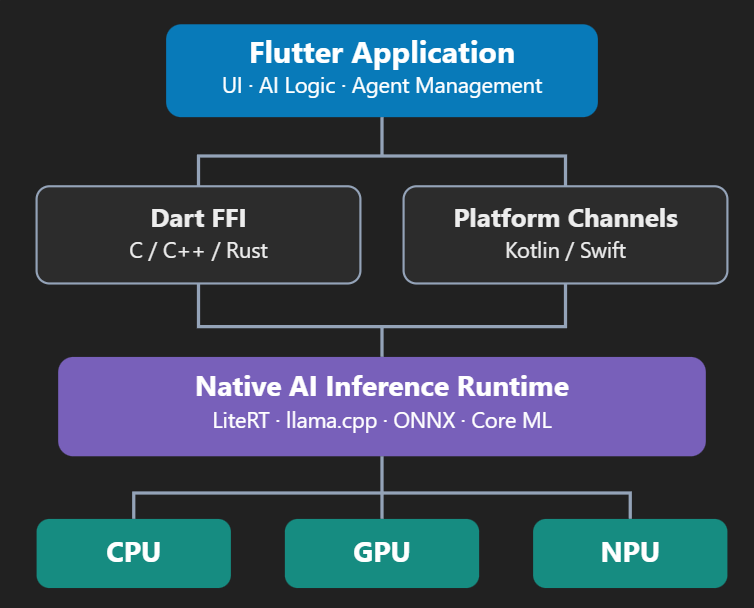
A Flutter-based application can coordinate hardware access, asynchronous communication, sensor configuration, inference requests, device discovery and real-time visualization.
The key architectural principle is to separate the application control plane from computationally intensive native processing.
4.1 The Flutter Control Plane
Flutter and Dart can manage:
- Device discovery and session lifecycle.
- Camera and sensor configuration.
- Capability advertisement.
- Inference request scheduling.
- Streaming analytical results.
- Device health and thermal monitoring.
- Authorization and permission interfaces.
- Real-time visualization.
- Experimental data collection.
- Performance benchmarking.
Dart can implement substantial parts of the networking, protocol and coordination logic.
Flutter does not need to replace native GPU runtimes or real-time robotics controllers.
4.2 Native Hardware Integration
Flutter provides several mechanisms for integrating native software components.
| Integration Mechanism | Physical AI Application |
|---|---|
| Platform Channels | Camera, Android sensors and native device services |
| Dart FFI | C/C++ inference runtimes and signal-processing libraries |
| Dart Isolates | Background parsing and CPU-intensive transformations |
| Native Textures | Efficient camera and video rendering |
| Dart Streams | Continuous telemetry and inference events |
| CustomPainter | Detection overlays and spatial visualizations |
Official engineering references:
- Flutter Architectural Overview
- Flutter Platform Channels
- Dart C Interoperability
- Flutter Concurrency and Isolates
A well-designed implementation should avoid transferring every raw camera frame through ordinary Flutter platform-channel messages.
Instead, native components can manage image buffers, encoding and inference while Flutter receives compact analytical metadata.
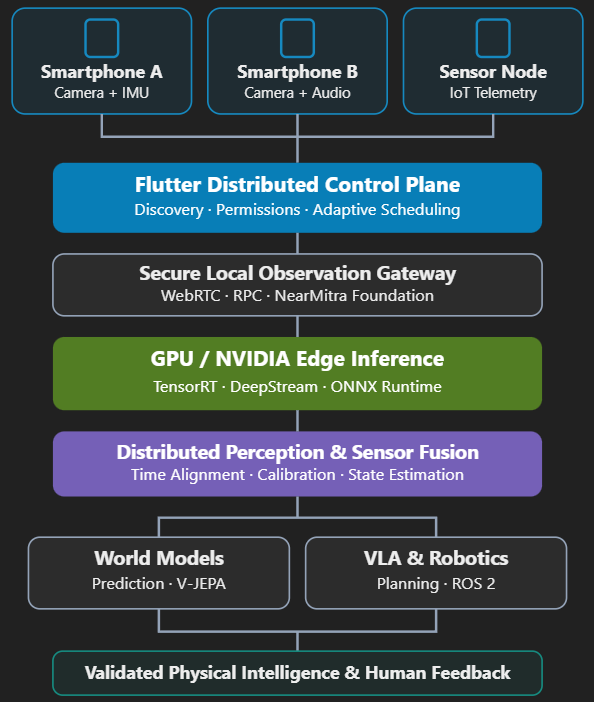
5. Proposed Distributed Physical AI Architecture
A practical research architecture can be divided into six major layers.
┌──────────────────────────────────────────┐
│           Flutter Control Plane          │
│ Device UI | Telemetry | Visualization    │
├──────────────────────────────────────────┤
│         Device Coordination Layer        │
│ Discovery | Identity | Session Control   │
├──────────────────────────────────────────┤
│           Native Sensing Layer           │
│ CameraX | IMU | Audio | SensorManager     │
├──────────────────────────────────────────┤
│          Communication Transport         │
│ WebRTC | Secure RPC | Local Networking   │
├──────────────────────────────────────────┤
│          Distributed Edge Intelligence   │
│ ONNX | TensorRT | DeepStream | LiteRT     │
├──────────────────────────────────────────┤
│       Physical Intelligence Services     │
│ Sensor Fusion | World Models | VLA        │
└──────────────────────────────────────────┘
The architecture deliberately separates computational responsibilities.
A smartphone node captures observations and performs lightweight preprocessing.
A nearby workstation or embedded AI computer executes more expensive inference.
A coordination service manages observation delivery, timing and capability selection.
An optional robotics subsystem consumes validated analytical results.
Flutter provides the application-level coordination and visualization environment across these components.
There is no requirement that every service be implemented in Dart. Go, Python, Kotlin, C++ and Rust can participate through documented communication contracts.
6. Building a Smartphone-Based Intelligent Vision Node
6.1 Camera Acquisition
The first practical implementation should focus on converting an Android smartphone into a configurable vision node.
Flutter can provide camera configuration, preview and session management, while native Android code handles image acquisition and preprocessing.
Google’s CameraX Image Analysis API provides an appropriate foundation.
A vision node should support configurable parameters such as:
| Parameter | Initial Experimental Setting |
|---|---|
| Capture resolution | 1280 × 720 |
| Preview frame rate | Up to 30 FPS, hardware dependent |
| Analytical sampling rate | 5–10 FPS |
| Transport | Local network |
| Inference mode | Local, remote or adaptive |
| Frame queue | Bounded, latest-frame policy |
| Image format | Native YUV or encoded image |
| Camera activation | Explicit owner authorization |
These values are proposed starting configurations, not measured performance results.
6.2 Understanding Backpressure
Camera acquisition and AI inference rarely operate at identical speeds.
A smartphone camera may produce 30 frames per second, while an inference service processes only eight.
If the application attempts to preserve every frame, the queue grows by approximately 22 frames per second.
After ten seconds, more than 200 frames could be waiting for processing.
The AI would increasingly analyze historical rather than current observations.
For interactive perception, processing outdated information can be worse than dropping intermediate frames.
CameraX supports a latest-image backpressure strategy that discards intermediate frames when the analyzer cannot keep pace.
An illustrative Kotlin implementation is:
val analysis = ImageAnalysis.Builder()
    .setBackpressureStrategy(
        ImageAnalysis.STRATEGY_KEEP_ONLY_LATEST
    )
    .build()

analysis.setAnalyzer(cameraExecutor) { image ->
    try {
        val timestamp = image.imageInfo.timestamp
        val rotation = image.imageInfo.rotationDegrees

        // Experimental pipeline:
        // Sample, copy or encode required image data.
        // Submit to a bounded processing queue.

    } finally {
        image.close()
    }
}
The implementation must copy or safely retain required image data before releasing the image buffer.
The analyzer should not wait synchronously for remote inference.
Reference: Android ImageAnalysis API.
6.3 Event-Based Image Transmission
Continuous image transmission is not always necessary.
A more resource-efficient smartphone node could perform basic local analysis and transmit detailed observations only when relevant changes occur.
Continuous Camera Input
           ↓
Lightweight Local Detection
           ↓
Relevant Visual Change?
       /          \
      No          Yes
      ↓            ↓
 Continue      Send Selected Frame
                    ↓
             Remote AI Analysis
Potential triggering mechanisms include scene changes, motion, object appearance, periodic sampling and user-initiated inspection.
This architecture can reduce network traffic and remote computational demand.
However, event-triggered sampling may also miss important observations. Its effectiveness must be measured against a continuously sampled baseline.
7. The Real Engineering Cost of Streaming Vision Data
A frequently overlooked challenge in mobile AI is the volume of intermediate visual data.
An uncompressed RGB image with a resolution of 1920 × 1080 contains approximately:
1920 × 1080 × 3 bytes
= 6,220,800 bytes per frame
At 30 frames per second:
6,220,800 × 30
= 186,624,000 bytes per second

≈ 186.6 MB/s
≈ 1.49 Gbps
Actual native camera formats may use less memory than RGB, but continuous uncompressed transmission remains expensive.
A distributed perception system must therefore select an appropriate representation.
| Data Representation | Advantages | Limitations |
|---|---|---|
| Raw RGB frames | Maximum direct pixel access | Extremely high bandwidth |
| YUV camera buffers | More efficient native processing | Format and stride handling |
| JPEG snapshots | Simple remote inference | Compression cost and reduced temporal continuity |
| H.264 video | Efficient continuous streaming | Decoder and buffering requirements |
| Detection metadata | Very low bandwidth | Requires local inference |
| Feature embeddings | Compact semantic representation | Model compatibility and information-loss concerns |
For an illustrative prototype, transmitting five JPEG images per second at 100 KB per image requires approximately 4 Mbps before protocol overhead.
Sending only structured detections can reduce the required network capacity considerably.
The most appropriate choice depends on inference accuracy, observation freshness, bandwidth and energy consumption.
8. Designing a Distributed Sensor Node Beyond the Camera
Physical intelligence benefits from more than visual information.
A smartphone can also provide motion, orientation and environmental context.
For example, a camera image of a moving object may be ambiguous if the smartphone itself is moving.
The gyroscope and accelerometer can provide complementary information about device motion.
Android exposes supported device sensors through the native SensorManager API.
Flutter developers can also explore the sensors_plus package for supported sensor interfaces.
For higher-frequency collection, native buffering and batching may be preferable to forwarding each measurement independently to the Flutter UI.
8.1 Designing an Observation Contract
Every visual or sensor observation should include sufficient metadata for interpretation.
An illustrative observation schema is:
{
  "schemaVersion": 1,
  "deviceId": "vision-node-01",
  "sessionId": "experiment-001",
  "sequence": 1042,
  "observationType": "imu.sample",
  "captureTimestampNs": "184523400000",
  "clockDomain": "device-monotonic",
  "coordinateFrame": "phone-01-imu",
  "accelerometer": {
    "x": 0.12,
    "y": 0.03,
    "z": 9.79,
    "unit": "m/s2"
  },
  "gyroscope": {
    "x": 0.01,
    "y": 0.02,
    "z": 0.04,
    "unit": "rad/s"
  }
}
The corresponding camera metadata should identify the capture timestamp, image resolution, rotation, camera identity and applicable calibration profile.
The observation contract should remain independent of Flutter widget classes and specific inference frameworks.
A versioned contract enables heterogeneous devices to participate without requiring identical application implementations.
9. Sensor Fusion: The Foundation of Reliable Physical Intelligence
Sensor fusion is the process of combining complementary observations to estimate the state of a physical system.
Simply concatenating sensor readings is not sufficient.
A reliable fusion pipeline must understand when and where each measurement was captured, how accurate it is and how it relates to other observations.
9.1 Temporal Synchronization
Independent smartphones maintain independent clocks.
A timestamp generated by Smartphone A cannot automatically be compared with a timestamp generated by Smartphone B.
Each node may have a different clock offset and drift.
A local synchronization service could estimate the relationship between device clocks using repeated timestamp exchanges.
For more advanced systems, contributors could investigate:
- Network Time Protocol.
- Precision Time Protocol, where supported.
- Hardware-assisted timestamping.
- Visual synchronization events.
- Clock-offset estimation and drift correction.
The system should monitor synchronization uncertainty rather than assume that synchronization is perfect.
For visual-inertial processing, camera timestamps also need to be checked against the device’s sensor clock domain.
CameraX documents monotonic image timestamps, but compatibility across capture sources and devices requires additional validation.
9.2 Spatial Calibration
Consider two smartphones observing the same physical object from different locations.
The object’s bounding box in Smartphone A does not occupy the same image coordinates as its bounding box in Smartphone B.
To combine these observations in a common spatial representation, the system needs camera calibration.
Intrinsic calibration describes the internal properties of a camera, including focal length and lens distortion.
Extrinsic calibration describes the camera’s position and orientation relative to another coordinate frame.
A simplified coordinate transformation can be represented as:
Point_world = R × Point_camera + tWhere:
Rrepresents rotation.trepresents translation.Point_camerarepresents a three-dimensional point in the camera coordinate system.
A two-dimensional bounding box alone does not provide the three-dimensional point required for this transformation.
Depth estimation, triangulation or additional spatial constraints are necessary.
Developers can investigate:
9.3 Estimation Under Uncertainty
More advanced sensor fusion algorithms may use:
- Complementary filters.
- Extended Kalman filters.
- Unscented Kalman filters.
- Particle filters.
- Factor graph optimization.
Projects such as GTSAM provide tools for investigating probabilistic estimation and factor graph-based sensor fusion.
A research implementation should preserve confidence and uncertainty information rather than presenting every observation as an established physical fact.
10. NVIDIA Jetson and GPU-Accelerated Edge Intelligence
The computational requirements of advanced computer vision and Physical AI models frequently exceed the practical capabilities of mobile devices.
A nearby edge computer can execute specialized workloads while smartphones provide distributed observations.
The NVIDIA Jetson platform is particularly relevant for investigating this architecture because it combines embedded computing with GPU acceleration.
A proposed deployment could involve:
Flutter Smartphone Nodes
          ↓
Secure Local Communication
          ↓
Edge Inference Gateway
          ↓
NVIDIA Jetson / GPU Workstation
          ↓
TensorRT / DeepStream / ONNX
          ↓
Structured Inference Results
          ↓
Flutter Visualization
10.1 NVIDIA DeepStream
NVIDIA DeepStream provides an accelerated video analytics framework for processing streaming visual inputs.
It can serve as a reference for multi-stream vision pipelines involving decoding, preprocessing, inference and analytical metadata generation.
A conceptual pipeline could be:
Authorized Smartphone Video Streams
                 ↓
Hardware-Assisted Video Decoding
                 ↓
Stream Management and Batching
                 ↓
TensorRT Model Inference
                 ↓
Object Tracking
                 ↓
Analytical Metadata Publisher
                 ↓
Flutter Dashboard
If smartphone video arrives through WebRTC, an appropriate receiving and media-adaptation component is required.
A smartphone WebRTC stream should not be assumed to be directly compatible with every DeepStream input configuration.
10.2 TensorRT and ONNX Runtime
Developers working with GPU-enabled inference can investigate:
A hardware-agnostic architecture should permit alternative inference providers, including CPU-based ONNX Runtime and supported mobile inference runtimes.
NVIDIA-specific acceleration can be introduced as an optional capability rather than a mandatory application dependency.
11. Adaptive Compute Offloading: Should AI Run on the Phone or Nearby Computer?
A distributed Physical AI system should not always send every task to a remote GPU.
For some operations, local inference may be faster and more energy-efficient.
For computationally expensive models, remote execution may provide significant benefits.
The central engineering problem is deciding where a given workload should execute.
Research into mobile edge computing identifies computation offloading as an important mechanism for managing mobile resource limitations.
Relevant research includes:
- Shakarami et al., A Survey on the Computation Offloading Approaches in Mobile Edge Computing, 2020.
- Computation Offloading in Mobile Edge Computing Networks: A Survey, 2022.
- Baidya and Moh, Empowering Real-Time Applications through Mobile Edge Computing, 2026.
11.1 A Latency-Based Offloading Model
Remote inference time can be approximated as:
T_remote =
    T_capture
  + T_encode
  + T_upload
  + T_queue
  + T_inference
  + T_download
  + T_render
The scheduler should compare this with the complete local processing time.
Consider the following hypothetical measurement scenario:
| Processing Stage | Example Latency |
|---|---|
| Camera capture | 12 ms |
| Image encoding | 8 ms |
| Network upload | 22 ms |
| Remote queue | 10 ms |
| GPU inference | 25 ms |
| Result download | 5 ms |
| Flutter rendering | 8 ms |
| Total | 90 ms |
If equivalent local inference requires 180 ms end to end, remote execution may be preferable.
However, if wireless congestion increases upload latency to 200 ms, the same workload could become more suitable for local execution.
These numbers are illustrative calculations, not actual benchmark measurements.
11.2 Multi-Objective Scheduling
A more advanced scheduler could consider:
Scheduling Cost =
    α × Expected Latency
  + β × Energy Consumption
  + γ × Thermal Pressure
  + δ × Network Cost
  + ε × Deadline Violation Risk
The metrics should be normalized before applying weights.
Model compatibility, authorization and device availability should be treated as eligibility constraints rather than optional performance preferences.
11.3 Experimental Dart Scheduler
A simplified initial policy could be implemented in Dart.
enum InferenceTarget {
  local,
  edge,
  unavailable,
}

InferenceTarget selectTarget({
  required bool localModelAvailable,
  required bool edgeModelAvailable,
  required bool edgeAuthorized,
  required double localLatencyMs,
  required double remoteLatencyMs,
  required double deadlineMs,
}) {
  final localEligible =
      localModelAvailable &&
      localLatencyMs <= deadlineMs;

  final edgeEligible =
      edgeModelAvailable &&
      edgeAuthorized &&
      remoteLatencyMs <= deadlineMs;

  if (localEligible &&
      (!edgeEligible ||
       localLatencyMs <= remoteLatencyMs)) {
    return InferenceTarget.local;
  }

  if (edgeEligible) {
    return InferenceTarget.edge;
  }

  return InferenceTarget.unavailable;
}
A production scheduler would require smoothed measurements, failure recovery, thermal constraints, policy enforcement and protection against frequent switching between execution targets.
This introduces a valuable research opportunity for developing adaptive intelligence orchestration directly in Dart.
12. Bringing World Models into Distributed Physical AI
Traditional object detection answers questions about the current image.
A world model attempts to represent aspects of the environment and predict how its state may evolve.
This introduces a different level of intelligence.
For example:
- Object detection identifies a moving container.
- Temporal reasoning estimates its direction of movement.
- A predictive world model may estimate possible future positions.
- An action-conditioned model may predict how a proposed action could change the observed environment.
12.1 V-JEPA 2 and Predictive Visual Intelligence
Meta’s V-JEPA 2 research investigates learning predictive representations from visual observations.
The research also explores action-conditioned prediction and planning for selected robotic manipulation tasks.
Primary research:
Source code:
This research provides an important conceptual direction for future distributed smartphone-based perception systems.
Instead of processing independent images exclusively, a temporal intelligence service could analyze sequences of observations and maintain an evolving representation of selected environmental conditions.
12.2 A Proposed Distributed World-State Pipeline
Multiple Smartphone Observations
               ↓
Temporal and Spatial Alignment
               ↓
Observation Representation
               ↓
Shared Physical State Estimation
               ↓
Predictive Model
               ↓
Possible Future States
               ↓
Planning and Human Interpretation
A practical early-stage experiment should begin with simple state prediction, such as estimating the motion of objects in a controlled environment.
Integrating a research-grade world model should follow only after reliable temporal and spatial observation processing is established.
V-JEPA 2 is not a ready-made universal multi-camera fusion engine. Additional model adaptation and infrastructure would be necessary.
13. Vision-Language-Action Models: Connecting Perception with Physical Behavior
Vision-Language-Action models represent another important direction in Physical AI research.
A VLA model connects visual observations and language instructions to action representations.
Consider the instruction:
Identify the blue object on the experimental table and place it in the designated container.
A suitable robotic policy must interpret the visual observation, understand the instruction and generate actions compatible with the robot’s hardware.
13.1 OpenVLA Research
OpenVLA is an open-source Vision-Language-Action research model developed using a large collection of robotic demonstrations.
The published architecture uses a language-model backbone combined with visual representations to support robotic manipulation policies.
Primary research:
Moo Jin Kim et al., OpenVLA: An Open-Source Vision-Language-Action Model, 2024.
Research repositories:
13.2 Smartphone-Assisted Robotic Perception
An interesting experimental direction involves using smartphones as supplementary external observation devices for robotic systems.
Phone A: Front Observation
Phone B: Side Observation
Robot: Onboard Camera
             ↓
Calibrated Observation Gateway
             ↓
Compatible Robotic Policy / VLA
             ↓
Proposed Action
             ↓
Independent Safety Controller
             ↓
Robot Execution
The smartphone nodes could provide additional views of objects that are partially obscured from the robot’s onboard camera.
However, existing VLA policies are generally sensitive to their training observations, camera configuration, robot embodiment and action representation.
Adding arbitrary smartphone camera streams does not automatically improve policy performance.
Contributors would need to investigate observation adaptation, training data compatibility and controlled policy evaluation.
Flutter’s appropriate role is visualizing observations, managing authorized sessions, presenting proposed actions and supervising experiments.
Hard real-time motion control should remain within validated native robotic controllers.
14. Integrating ROS 2 with Flutter-Based Physical AI Systems
The Robot Operating System 2 ecosystem provides communication infrastructure for robotics applications.
A future Flutter-based perception node could interact with ROS 2 through a dedicated gateway.
Flutter Vision and Sensor Node
              ↓
Authenticated Edge Gateway
              ↓
ROS 2 Bridge
              ↓
Robot Sensors and State Estimation
              ↓
Robotics Planning Infrastructure
Possible integrations include sensor messages, camera metadata, transforms, robot status and experiment results.
A gateway could publish approved smartphone observations into suitable ROS message types.
| Smartphone Observation | Possible ROS 2 Representation |
|---|---|
| Camera image | sensor_msgs/Image |
| Camera calibration | sensor_msgs/CameraInfo |
| Inertial measurements | sensor_msgs/Imu |
| Geographic position | sensor_msgs/NavSatFix |
| Coordinate transformations | tf2 |
| Device diagnostics | diagnostic_msgs |
ROS 2 Quality of Service policies can help distinguish time-sensitive sensor observations from messages requiring reliable delivery.
For example, a live camera observation may tolerate occasional dropped frames, while configuration updates require dependable communication.
Relevant resources:
The gateway must enforce permissions independently of the Flutter interface.
An unrestricted bridge exposing robotic command topics to untrusted local-network clients would introduce significant security and safety risks.
15. NearMitra as an Open-Source Connectivity Foundation
One of the practical barriers to distributed Physical AI development is building reliable device connectivity infrastructure.
Developers frequently need discovery, session management, streaming, permission controls and cross-device communication before they can begin experimenting with AI models.
NearMitra is an open-source Android and Windows project that already explores several of these infrastructure capabilities.
Its documented functionality includes device discovery, camera and audio streaming, local networking, file exchange and permission-based access to configured AI engines.
These capabilities make NearMitra an interesting starting point for investigating smartphone-based distributed perception.
15.1 Existing Capabilities and Proposed Extensions
| Existing NearMitra Foundation | Proposed Physical AI Extension |
|---|---|
| Nearby device discovery | Vision and sensor capability discovery |
| Camera streaming | Vision inference and analytical metadata |
| Cross-device communication | Timestamped observation transport |
| Nearby AI | Specialized edge inference providers |
| Owner-controlled sessions | Sensor-specific access policies |
| Flutter and Kotlin integration | Native IMU and camera calibration modules |
| Windows host application | Edge perception gateway |
| Battery and location snapshots | Configurable sensor observation services |
The proposed extensions are not presented as currently implemented functionality.
NearMitra’s documentation explicitly distinguishes its streaming capabilities from deferred production vision analytics.
Developers should study the existing architecture before adding independent networking or streaming frameworks.
15.2 Proposed NearMitra Perception Extension
A community-developed extension could introduce a modular perception service.
NearMitra Core Connectivity
             ↓
Experimental Perception Extension
             │
             ├── Camera Observation Adapter
             ├── Native Sensor Adapter
             ├── Capability Registry
             ├── Secure Observation Gateway
             ├── Edge Inference Provider
             └── Flutter Analytics Dashboard
Rather than redesigning the entire project, contributors could begin by extending a single approved camera session with an object-detection result channel.
Project resources:
- NearMitra Official Website
- GitHub Repository
- Flutter Source Code
- Native Android Source Code
- Windows Host Application
- Technical Documentation
- Application Downloads
- Contribution Guidelines
For additional architectural context:
NearMitra AI: Open-Source Local AI, P2P File Sharing and Device Connectivity
16. MCP as an Optional Interface for Physical Intelligence
The Model Context Protocol provides an additional opportunity to expose perception and sensor services to compatible AI hosts.
MCP should operate at the semantic service layer rather than carry continuous high-frequency camera frames or raw sensor streams.
A future gateway could expose tools such as:
| Proposed MCP Tool | Purpose |
|---|---|
list_perception_nodes | Discover authorized vision and sensor devices |
get_scene_observation | Retrieve a recent analytical scene description |
request_snapshot | Request an explicitly approved image |
get_environment_summary | Retrieve processed sensor information |
get_object_observations | Retrieve recent structured detections |
get_device_health | Inspect node availability and resource conditions |
An AI assistant could use these tools to interpret environmental observations without implementing every device-specific interface.
Local AI Agent
      ↓
MCP Client
      ↓
Physical AI MCP Gateway
      ↓
Authorized Perception Services
      ↓
Smartphone and Edge Intelligence Nodes
High-frequency data transport should remain separate from MCP.
MCP tool requests must also respect device-level permission enforcement, observation freshness and access revocation.
Research and implementation references:
17. Practical Research Prototype: A Flutter Distributed Vision Laboratory
The most effective way to investigate this architecture is through a controlled, reproducible laboratory experiment.
17.1 Required Infrastructure
An initial experiment could use:
| Component | Purpose |
|---|---|
| Two Android smartphones | Independent visual observations |
| One local Wi-Fi network | Device communication |
| One desktop or laptop | Inference coordinator |
| Optional NVIDIA GPU or Jetson | Accelerated inference |
| Flutter application | Configuration and visualization |
| Native CameraX module | Camera acquisition |
| ONNX-compatible detection model | Initial inference workload |
| Printed calibration target | Spatial calibration reference |
| Local recording service | Experiment and benchmark storage |
A GPU is not mandatory for the first experiment. CPU-based inference can establish a baseline.
17.2 Suggested Experimental Source Structure
distributed_physical_ai/
│
├── mobile/
│   ├── lib/
│   │   ├── discovery/
│   │   ├── sensors/
│   │   ├── perception/
│   │   ├── transport/
│   │   ├── scheduling/
│   │   └── visualization/
│   │
│   └── android/
│       └── native_vision/
│
├── edge_gateway/
│   ├── api/
│   ├── inference/
│   ├── synchronization/
│   ├── fusion/
│   └── security/
│
├── contracts/
│   ├── observations.proto
│   └── detections.proto
│
├── experiments/
│   ├── calibration/
│   ├── latency/
│   └── energy/
│
└── documentation/
This is a proposed independent module structure, not the current NearMitra repository layout.
17.3 Research Phases
Phase 1 — Single-Node Perception
Capture images from one smartphone, submit selected observations to the edge host and return structured detection results.
Phase 2 — Live Analytical Streaming
Introduce continuous sampling, observation sequencing, bounded queues and real-time detection overlays.
Phase 3 — Distributed Observation
Add a second smartphone and compare detection availability across independent viewpoints.
Phase 4 — Sensor Fusion
Introduce inertial measurements, camera calibration, clock synchronization and controlled spatial estimation.
Phase 5 — Adaptive Inference
Compare local inference, remote inference and dynamic workload selection under different networking conditions.
Phase 6 — Predictive Intelligence
Evaluate temporal scene understanding and simple predictive models before introducing more advanced world-model research.
Phase 7 — Robotics Integration
Publish validated observations to a ROS 2 simulation environment before investigating physical robotic execution.
This staged approach makes it possible to evaluate each architectural component independently.
18. Implementing the Flutter Analytical Visualization Layer
A central requirement is rendering AI results without compromising camera-preview performance.
A Flutter application can receive structured detections from the edge inference gateway.
Example result:
{
  "deviceId": "vision-node-01",
  "frameId": 1042,
  "modelId": "experimental-detector-v1",
  "inferenceMs": 28.4,
  "coordinateSpace": "normalized-image",
  "imageWidth": 1280,
  "imageHeight": 720,
  "detections": [
    {
      "label": "bottle",
      "confidence": 0.94,
      "boundingBox": {
        "x": 0.31,
        "y": 0.25,
        "width": 0.18,
        "height": 0.28
      }
    }
  ]
}
These values are illustrative, not real inference outputs.
Flutter can use CustomPainter to render bounding boxes over a camera preview.
However, accurate visualization requires accounting for:
- Camera sensor rotation.
- Preview cropping.
- Mirrored front-camera output.
- Letterboxing applied during model preprocessing.
- Differences between inference and preview resolution.
- Delayed inference responses.
- The relationship between the displayed frame and detection frame.
A mathematically accurate detection can still appear incorrectly positioned if these transformations are ignored.
The UI should also display the age of the observation, allowing users to distinguish live analytical results from delayed predictions.
Reference: Flutter Performance Best Practices.
19. Futuristic Real-World Applications
19.1 Collaborative Agricultural Intelligence
A greenhouse or agricultural research facility could use existing smartphones as distributed visual observation nodes.
The devices could capture crop images from selected viewpoints while environmental sensors collect humidity, temperature and soil-moisture measurements.
A nearby workstation could process these observations using specialized models.
Researchers could investigate correlations between changing environmental conditions and visible plant characteristics.
Flutter could provide a unified field application for visual observations, historical measurements and analytical reports.
Future extensions might enable predictive crop-monitoring research, subject to validated agricultural models and expert oversight.
19.2 Distributed Industrial Visual Inspection
Manufacturing facilities often require observations from multiple positions.
Lower-cost smartphone nodes could supplement fixed inspection cameras within controlled experimental setups.
An edge inference system could examine selected images for predefined visual defects or missing components.
Multiple perspectives could improve observation coverage where one camera is partially obstructed.
The research challenge would involve consistent lighting, calibrated viewpoints, defect-model accuracy and synchronization.
Such a prototype should not replace certified industrial safety or quality-control systems without appropriate validation.
19.3 Intelligent Robotics Laboratories
Universities could reuse existing smartphones to create additional observation viewpoints around robotic research platforms.
A Flutter perception application could display robot state, camera observations and model-generated analytical results.
Researchers could evaluate whether additional viewpoints improve selected manipulation tasks after appropriate sensor and policy integration.
This could provide a relatively accessible environment for experimenting with distributed robotics perception.
19.4 Distributed Spatial Intelligence and Digital Twins
Multiple smartphone cameras could capture observations of a controlled physical environment.
A workstation could attempt to reconstruct selected spatial characteristics using calibrated multi-view geometry.
The resulting representation could contribute to a continuously updated digital model of the environment.
Relevant open-source projects include:
Future research could combine spatial reconstruction with predictive visual models.
Monocular depth predictions should not automatically be treated as accurate metric measurements without calibration and validation.
19.5 Infrastructure Inspection
A technician could use a smartphone to observe equipment while a nearby computing system performs visual recognition and retrieves relevant maintenance information.
An AI service could correlate observations with approved equipment documents.
Flutter could present visual annotations, supporting evidence and inspection notes.
With appropriate validation, this architecture could become a useful research foundation for local, privacy-conscious inspection assistance.
19.6 Intelligent Emergency Response Research
Distributed mobile nodes could potentially contribute approved visual and environmental observations during controlled emergency-response exercises.
A local coordinator could combine available information without depending entirely on public internet connectivity.
Research would need to address intermittent connections, incomplete observations, data prioritization and battery management.
Experimental AI systems must not be considered substitutes for validated emergency communications or professional decision-making infrastructure.
19.7 Personal Spatial AI Environments
A longer-term research direction involves personal computing environments in which cameras, mobile devices, embedded sensors and local AI services cooperate.
Instead of requiring each device to maintain independent environmental awareness, authorized systems could contribute observations to a shared state-estimation service.
A private AI assistant could then interpret selected environmental changes using permission-controlled interfaces.
Such a system would require rigorous consent, privacy boundaries, retention policies and visible sensor-activation controls.
20. Benchmarking and Research Evaluation
A research-oriented implementation must move beyond architectural diagrams and demonstrate measurable behavior.
20.1 Research Hypotheses
The proposed prototype could evaluate the following hypotheses:
H1: Remote GPU inference can reduce end-to-end processing latency for selected models compared with mobile-only execution.
H2: Event-triggered transmission can reduce network utilization while preserving acceptable detection coverage.
H3: Calibrated multi-camera observations can reduce selected occlusion-related detection failures.
H4: Adaptive compute offloading can improve the latency-energy trade-off under varying network conditions.
H5: Native camera processing and compact metadata delivery can reduce Flutter UI overhead compared with continuous raw-frame delivery.
Each hypothesis should be treated as an experimentally testable proposition rather than an assumed outcome.
20.2 Experimental Comparisons
| Configuration | Description |
|---|---|
| A | Single smartphone with local inference |
| B | Single smartphone with remote CPU inference |
| C | Single smartphone with remote GPU inference |
| D | Multiple smartphones with remote inference |
| E | Multiple smartphones with calibrated observation fusion |
| F | Adaptive local and remote inference |
The experiments should use equivalent model configurations where possible and explicitly document unavoidable differences.
20.3 Performance Metrics
| Research Dimension | Measurement |
|---|---|
| End-to-end latency | Median, P95 and P99 |
| Observation freshness | Capture-to-consumption age |
| Network efficiency | Bytes transmitted per observation |
| Inference throughput | Processed frames per second |
| Detection accuracy | Precision, recall and mAP |
| Tracking quality | Identity consistency and tracking metrics |
| Sensor synchronization | Estimated clock offset and uncertainty |
| Spatial estimation | Position and orientation error |
| Energy efficiency | Energy consumed per processed observation |
| Thermal behavior | Temperature trends and throttling |
| Flutter rendering | Frame timing and dropped UI frames |
| Reliability | Session recovery and unsuccessful requests |
20.4 Reproducible Experimental Conditions
Network testing should include different throughput levels, latency conditions and packet-loss scenarios.
Each experiment should record:
- Smartphone model and Android version.
- Flutter and native SDK versions.
- Edge-host hardware.
- Model architecture and model weights.
- Model quantization settings.
- Camera resolution and sampling frequency.
- Network topology.
- Experimental duration.
- Environmental conditions.
- Software commit identifiers.
Relevant evaluation resources include MLCommons Benchmarks and Flutter Performance Profiling.
A well-documented negative result can be as valuable as a successful optimization because it identifies architectural limitations.
21. Security, Privacy and Physical Safety
Distributed Physical AI introduces a more consequential threat surface than a conventional mobile application.
It may process visual information about physical environments, private spaces, device locations and human activity.
Security must therefore be incorporated into the architecture from the beginning.
21.1 Device Identity
Network discovery should not automatically grant access to a sensor or computing resource.
Devices should establish authenticated identities and session-specific authorization.
The system should allow resource owners to revoke access immediately.
21.2 Transport Security
Sensitive camera, sensor and inference data should use appropriately authenticated and encrypted transport.
Developers extending an existing networking project must evaluate its transport-specific security guarantees.
For example, NearMitra’s documentation distinguishes WebRTC transport security from its existing local TCP communication paths.
Application-level owner approval should not be confused with cryptographic authentication or universal end-to-end encryption.
21.3 Sensor Privacy
Camera and microphone activation must be explicit, visible and revocable.
A perception node should support configurable data-retention periods and avoid unnecessary raw media storage.
Android background camera and microphone restrictions must also be respected.
Reference: Android Foreground Service Documentation.
21.4 Independent Physical Safety
AI-generated physical actions must not pass directly from a generative model to unrestricted actuation.
A separate control system should enforce validated operating limits, authorization, emergency stopping and hardware-specific safety requirements.
Network delays, stale observations and incomplete information must be treated as potential failure conditions.
For early research, robotics simulation provides a more appropriate experimental environment than unrestricted physical execution.
Interactive research model: Network bandwidth and inference latency
22. Open-Source Research Projects for Flutter Developers
The proposed architecture creates several independent research and contribution opportunities.
| Research Project | Primary Technology | Complexity |
|---|---|---|
| Flutter Vision Node SDK | Flutter, Dart, Kotlin | Intermediate |
| Adaptive Camera Sampling | CameraX, Native Android | Intermediate |
| Distributed IMU Service | Kotlin, Dart | Intermediate |
| Observation Protocol | Protobuf, Go, Dart | Intermediate |
| GPU Inference Adapter | ONNX, TensorRT | Advanced |
| Multi-Camera Calibration | OpenCV, Kalibr | Advanced |
| Adaptive Inference Scheduler | Dart, Go | Advanced |
| Physical AI Visualization | Flutter, CustomPainter | Intermediate |
| ROS 2 Perception Gateway | ROS 2, Python, Go | Advanced |
| Predictive Scene Intelligence | V-JEPA, PyTorch | Research-intensive |
| VLA Observation Adapter | OpenVLA, LeRobot | Research-intensive |
| Physical Intelligence MCP Server | MCP, Go, Python | Advanced |
| Energy and Latency Benchmarking | Android, Flutter | Advanced |
Developers interested in building on an existing connectivity foundation can begin by forking NearMitra.
Contributors should review its repository structure, development workflow and GPL-3.0-only licensing requirements before distributing modified implementations.
The projects listed here are suggested research directions, not claims of existing GitHub issues or completed integrations.
23. Limitations and Open Research Questions
Several fundamental limitations remain unresolved.
Consumer smartphones vary significantly in sensor quality, camera characteristics and access to hardware acceleration.
Wireless networking introduces variable latency, interference and unpredictable connection behavior.
Multi-device calibration becomes difficult when smartphones are repositioned during operation.
Continuous camera processing consumes battery power and may produce thermal throttling.
Vision models trained under one observation configuration may perform poorly when camera angles, lighting or environmental conditions change.
World models and VLA policies introduce additional computational and data requirements.
These limitations create important research questions:
- Can observation quality guide dynamic selection of sensing devices?
- Can a system detect when its spatial calibration becomes invalid?
- How much network bandwidth is required for useful collaborative perception?
- Can smartphone nodes maintain acceptable battery life during extended sensing?
- When does distributed perception outperform a single high-quality camera?
- Can adaptive inference scheduling generalize across different mobile hardware?
- How should world-state uncertainty be represented across heterogeneous devices?
- Can external smartphone observations improve embodied AI policies without extensive retraining?
Answering these questions requires practical experiments rather than architectural speculation alone.
24. The Future of Flutter in Distributed Physical Intelligence
Flutter’s long-term relevance to AI engineering may extend beyond applications that consume cloud-hosted language-model APIs.
As intelligence becomes increasingly distributed across smartphones, edge computers, embedded systems and robotic platforms, application frameworks will need to coordinate complex computational environments.
Flutter could occupy an important position as a programmable control plane for such systems.
A Flutter-based smartphone node could be simultaneously:
- A sensing endpoint.
- A local inference environment.
- A network communication participant.
- A resource-aware computation client.
- A visualization interface.
- A human authorization gateway.
- A component of a distributed perception system.
This architecture creates a bridge between conventional mobile application engineering and emerging Physical AI research.
The innovation is not replacing every specialized AI technology with Flutter.
It is enabling heterogeneous technologies to participate in a coherent, accessible and interoperable intelligence environment.
Frequently Asked Questions
What is Distributed Physical AI?
Distributed Physical AI is an architectural approach in which multiple sensing, computing and potentially actuating systems cooperate to interpret and interact with physical environments.
Can Flutter be used for Physical AI?
Yes. Flutter can coordinate device communication, native sensor integration, inference workflows, robotics interfaces and analytical visualization.
Specialized native runtimes should handle computationally intensive inference and hard real-time control.
Can Android smartphones become AI sensor nodes?
Yes. Their cameras, motion sensors, connectivity and computing hardware provide a useful foundation for experimental distributed perception systems.
Available capabilities depend on device hardware and operating-system restrictions.
Can Flutter integrate NVIDIA Jetson?
Flutter applications can communicate with inference and robotics services running on NVIDIA Jetson through compatible network interfaces and gateways.
Direct GPU processing remains the responsibility of the native inference runtime.
What is the difference between a VLM and a VLA model?
A Vision-Language Model connects visual information with language.
A Vision-Language-Action model additionally generates action representations appropriate for a supported embodied system.
Can multiple smartphone cameras provide spatial intelligence?
Potentially. Reliable spatial estimation requires calibration, synchronization, appropriate geometry and compatible estimation algorithms.
Multiple camera feeds alone are insufficient.
Can NearMitra support Distributed Physical AI?
NearMitra’s existing local communication, camera streaming and cross-device AI accessibility provide a potential starting point.
Distributed sensor fusion, predictive models, advanced inference orchestration and robotics integration would require new development.
Can distributed Physical AI work without the internet?
Yes, selected workflows can operate entirely within a local network when models, runtime dependencies and services are available locally.
Cloud-dependent providers and externally hosted services still require internet access.
Is a GPU necessary for creating a prototype?
No. CPU inference can establish an initial experimental baseline.
GPU acceleration becomes relevant when workload complexity or performance requirements justify it.
Conclusion
The next generation of Physical AI infrastructure may not depend exclusively on expensive dedicated sensing hardware.
It may also emerge from smarter coordination of devices that already exist.
Smartphones provide cameras, sensors, local processing and wireless connectivity. Edge computers provide computationally intensive inference. Robotics frameworks provide access to physical systems. Predictive world models and VLA architectures introduce new possibilities for environmental understanding and controlled behavior.
Flutter can connect these capabilities through native hardware integration, distributed communication, adaptive computation and accessible interaction interfaces.
Open-source connectivity projects such as NearMitra provide a practical starting point for exploring portions of this architecture without recreating every foundational communication service.
The most promising research opportunities lie in the engineering challenges between these components: synchronization, calibration, observation quality, computational scheduling, interoperability, privacy and safe physical interaction.
The objective is not simply to run artificial intelligence on a smartphone.
It is to transform smartphones into intelligent participants in a collaborative physical-world computing environment.
The future of Physical AI may not be defined only by more powerful machines, but by how effectively existing machines learn to perceive, communicate and reason together.
Research References and Developer Resources
Primary Research Papers
- Kim, M. J., et al. (2024). OpenVLA: An Open-Source Vision-Language-Action Model. arXiv:2406.09246.
- Assran, M., et al. (2025). V-JEPA 2: Self-Supervised Video Models Enable Understanding, Prediction and Planning. arXiv:2506.09985.
- Shakarami, A., Ghobaei-Arani, M., and Shahidinejad, A. (2020). A Survey on the Computation Offloading Approaches in Mobile Edge Computing: A Machine Learning-Based Perspective. Computer Networks, 182. DOI: 10.1016/j.comnet.2020.107496.
- Computation Offloading in Mobile Edge Computing Networks: A Survey. (2022). Journal of Network and Computer Applications, 202. DOI: 10.1016/j.jnca.2022.103366.
- Baidya, T., and Moh, S. (2026). Empowering Real-Time Applications through Mobile Edge Computing: Survey on Joint Computation Offloading and Data Caching Strategies. Computer Science Review. DOI: 10.1016/j.cosrev.2026.100984.
Computer Vision, Spatial Intelligence and Sensor Fusion
Edge Computing and AI Inference
Physical AI, World Models and Robotics
Flutter and Android Engineering
- Flutter Architecture
- Flutter Platform Channels
- Dart FFI
- Flutter Isolates
- Android CameraX Image Analysis
- Android SensorManager
- Flutter Camera Package
- Flutter Sensors Plus
Open-Source Connectivity Infrastructure
- NearMitra Source Code
- NearMitra Technical Documentation
- Fork NearMitra
- Model Context Protocol
- gRPC
- Protocol Buffers
- WebRTC
FlutterFever — Exploring the intersection of mobile engineering, open-source systems, edge computing and next-generation artificial intelligence.
Nearmitra resources: