

NearMitra AI: Open-Source Local AI, P2P File Sharing & Device Connectivity

Exploring the Future of Connected Devices, Local Intelligence, Flutter Networking and Edge Computing
The modern digital ecosystem is increasingly distributed across smartphones, desktop computers, laptops, artificial intelligence engines, sensors, and connected hardware. Although these devices possess significant individual capabilities, they often operate within isolated software environments, requiring external services, cloud infrastructure, or multiple specialized applications to communicate and exchange resources.
What if these devices could communicate directly, share their intelligence, exchange files, access hardware capabilities, and collaborate within a connected digital ecosystem?
What if a smartphone could access an artificial intelligence model running on a nearby computer without downloading a large language model onto the mobile device?
What if local communication, artificial intelligence, multimedia streaming, hardware integration, and peer-to-peer networking could exist within a unified, open-source platform?
These questions form the technological foundation behind NearMitra.
Developed and published by FlutterFever, NearMitra is an open-source, local-first connectivity platform that brings together cross-device communication, wireless file transfers, permission-based AI sharing, multimedia streaming, and hardware integration.
Built using Flutter, Dart, Kotlin, Go, WebRTC, and modern networking technologies, NearMitra explores a broader approach to device connectivity—one in which connected devices can share not only information but also selected resources and intelligent capabilities.
Rather than positioning itself exclusively as a file-sharing application, NearMitra aims to establish a foundation for a more connected, resource-efficient, and intelligent computing environment.
Official resources:
- NearMitra Official Website
- Explore NearMitra on FlutterFever Studio
- GitHub Source Code
- Download Android and Windows Applications
1. What Is NearMitra?
NearMitra is a free and open-source cross-device connectivity platform designed to establish direct communication and resource-sharing capabilities between Android smartphones and Windows computers.
Its core philosophy is based on local-first computing, peer-to-peer communication, user-controlled resource access, and the effective utilization of existing hardware.
NearMitra AI combines several technology domains within a single ecosystem:
- Local network communication
- Peer-to-peer device connectivity
- Wireless file and folder sharing
- Distributed AI resource sharing
- Offline messaging
- Real-time voice and video communication
- Wireless audio streaming
- Camera and screen sharing
- Hardware and IoT integration
- Device discovery and management
- Future agentic AI and intelligent computing capabilities
Each of these domains traditionally requires a separate application, protocol, or service.
NearMitra brings them together through a shared connectivity architecture, enabling supported devices to participate in multiple workflows without requiring a separate connection system for every feature.
The broader vision is to transform independent computing devices into collaborative participants within a connected digital environment.
NearMitra is not simply about connecting devices. It is about connecting their capabilities.
2. Why NearMitra Was Developed
Modern computing devices are more powerful than ever before. Smartphones contain advanced processors, cameras, microphones, location sensors, and increasingly sophisticated AI accelerators. Desktop computers offer larger memory capacities, powerful GPUs, storage systems, and high-performance computing environments.
However, many of these capabilities remain confined to individual devices.
A smartphone may have insufficient memory to execute a large AI model, while a nearby desktop computer may have substantial unused computing capacity.
A computer may lack a camera or microphone, while a nearby smartphone already contains high-quality multimedia hardware.
An organization may rely on internet-based applications for communication between devices that are physically located within the same building.
These scenarios highlight a fundamental opportunity: existing devices can become significantly more useful when they can share their resources through an efficient and controlled connectivity layer.
NearMitra explores this opportunity through an architecture that reduces unnecessary separation between devices.
Its design objectives include improving local communication, enabling AI accessibility across devices, reducing avoidable cloud dependency, supporting existing hardware, and establishing the foundation for intelligent resource sharing.
This approach is particularly relevant as artificial intelligence moves beyond centralized cloud platforms toward local inference, edge computing, personal AI systems, and decentralized technology environments.
3. Understanding NearMitra’s Local-First Philosophy
Local-first computing prioritizes operations that can be performed within local devices and networks rather than automatically depending on remote infrastructure.
In a traditional cloud-centric architecture, a request may travel from a device to a remote server before reaching another device in the same physical environment.
While cloud infrastructure is valuable for globally distributed services, it is not always necessary for communication between nearby devices.
NearMitra prioritizes available direct connections for supported local workflows.
For example, when an Android smartphone and Windows computer are connected to the same accessible Wi-Fi network, they can discover one another and exchange supported data without requiring a remote cloud relay.
This approach can provide several practical advantages:
- Reduced dependency on internet availability
- Lower potential communication latency
- More direct control over local resources
- Reduced reliance on centralized infrastructure
- Improved utilization of existing network capacity
- Continued availability of supported offline workflows
Actual performance depends on network conditions, device specifications, operating system restrictions, and the specific feature being used.
It is also important to distinguish local-first architecture from a universal guarantee of privacy or end-to-end encryption. Local networking reduces certain external dependencies, but secure communication still requires appropriate authentication, authorization, encryption, and network configuration.
NearMitra adopts a local-first approach while retaining optional internet connectivity for supported remote communication scenarios.
4. How NearMitra Works
At a conceptual level, NearMitra operates through a series of interconnected stages.
First, compatible devices establish their presence within an accessible networking environment. Device discovery allows applications to identify other available NearMitra participants.
After discovery, users can establish a connection and interact with the selected device.
The available communication route determines how requests, messages, files, and supported media are exchanged.
Feature-specific permissions determine whether sensitive capabilities, such as shared AI engines, cameras, microphones, or device information, can be accessed.
The receiving device then processes the requested operation and returns the appropriate result.
Consider a simple example involving an Android smartphone and a Windows desktop computer:
- NearMitra runs on both devices.
- The devices connect to a reachable local network.
- NearMitra identifies the available peer.
- The user selects the discovered device.
- A supported communication or resource-sharing feature is requested.
- The receiving device validates the request and relevant permissions.
- The devices exchange the required data through the available connection.
The same general connectivity foundation supports multiple features, although the transport requirements differ between ordinary messaging, large file transfers, real-time media, and AI inference.
This separation between connectivity and application capabilities is an important architectural characteristic of NearMitra.
5. NearMitra AI: Bringing Local Artificial Intelligence Across Devices
One of the most significant capabilities of NearMitra is its approach to artificial intelligence resource sharing.
As large language models become increasingly accessible through local inference frameworks, more users are experimenting with AI models running directly on their personal computers.
However, running these models on every device is not always practical.
Large models may require substantial memory, storage, processing power, and energy. Smartphones have physical and thermal limitations that can make certain inference workloads unsuitable for direct mobile execution.
NearMitra AI addresses this challenge by enabling an authorized device to interact with a configured AI engine hosted by another accessible device.
For example, a Windows computer running an AI model through Ollama can act as an AI host. An Android smartphone connected through NearMitra can interact with that engine after receiving the necessary authorization.
The smartphone does not need to execute the same language model locally.
Instead, the computational workload remains on the host computer, while the mobile device acts as the interaction interface.
This creates a practical separation between AI computation and AI accessibility.
5.1 My AI and Nearby AI
NearMitra distinguishes between two important AI interaction concepts.
My AI represents the AI engine configured on the current device.
Nearby AI represents an AI engine made available by another connected and authorized device.
This distinction allows NearMitra to support device-specific AI configurations rather than presenting every connected engine as a single centralized service.
A user may configure an AI engine on a desktop computer and selectively grant access to a particular smartphone.
Access can subsequently be revoked when it is no longer required.
This permission-based approach is especially important because AI inference consumes computational resources and may involve sensitive prompts.
5.2 How Nearby AI Works with Ollama
Ollama provides a convenient environment for running compatible language models locally.
NearMitra integrates with a configured Ollama host, allowing a connected peer to request AI-generated responses.
The conceptual request flow involves:
- A user submitting a prompt from the client device.
- NearMitra resolving the selected AI host.
- The host checking whether the requesting device is authorized.
- The prompt being submitted to the configured inference engine.
- The AI model generating a response.
- Response data being streamed back to the requesting device.
Streaming enables the receiving interface to display generated content progressively rather than waiting for the complete response.
Cancellation support and continuing authorization checks provide additional control over active generation.
Learn more about running local models through the official Ollama website.
5.3 Making AI Accessible Without Installing Models on Every Device
Imagine an individual using a desktop computer equipped with 32 GB of RAM and a dedicated GPU.
The computer may be capable of running language models that are considerably larger than those suitable for the individual’s smartphone.
With NearMitra AI, the smartphone can become a convenient interface for the desktop-hosted model.
Potential applications include programming assistance, document-related discussions, educational questions, creative writing, text analysis, brainstorming, and general-purpose AI interactions.
The inference quality and speed depend on the selected model, host hardware, network conditions, and concurrent workloads.
NearMitra does not itself replace the AI model or inference engine. It provides the connectivity and interaction layer through which the configured engine becomes accessible.
5.4 Heterogeneous AI Resource Sharing
NearMitra’s broader AI vision extends beyond connecting a single smartphone to a single AI engine.
Different computers may host different types of models. One computer might be optimized for programming assistance, another for general language generation, and another for specialized reasoning.
A connected environment containing multiple AI hosts could provide access to different intelligent capabilities.
This architectural direction is particularly interesting because it allows AI infrastructure to reflect the hardware and requirements of individual users instead of assuming that every device must operate identically.
The current device-specific AI sharing functionality establishes an initial foundation for this concept.
Automatic workload distribution, capability-based model routing, and dynamic resource balancing remain future development possibilities rather than established production capabilities.
6. Distributed AI, Edge Computing and the Future of Personal Intelligence
Distributed artificial intelligence is a broad technology domain involving the distribution of AI-related operations across multiple computing resources.
Traditional centralized AI systems frequently depend on remote infrastructure that provides model hosting and inference.
Edge AI brings intelligent processing closer to the environment where data is generated or consumed.
NearMitra explores an intermediate and complementary approach: enabling nearby devices to access AI resources hosted within their own connected environment.
This is particularly relevant for personal computing, educational laboratories, small organizations, research environments, and developers experimenting with local AI.
Instead of requiring every participant to maintain a separate model installation, an accessible AI host may provide inference services to authorized peers.
The potential benefits include better hardware utilization, easier AI accessibility, reduced duplication of model storage, and greater flexibility in selecting computing resources.
However, AI model sharing should not be confused with distributed model training or splitting individual neural-network computations across multiple devices.
NearMitra’s existing Nearby AI functionality primarily concerns remote access to a configured inference engine.
More sophisticated distributed computing capabilities would require additional scheduling, discovery, orchestration, authentication, and resource-management infrastructure.
This distinction is important for understanding both the present capabilities and the future technological potential of NearMitra AI.
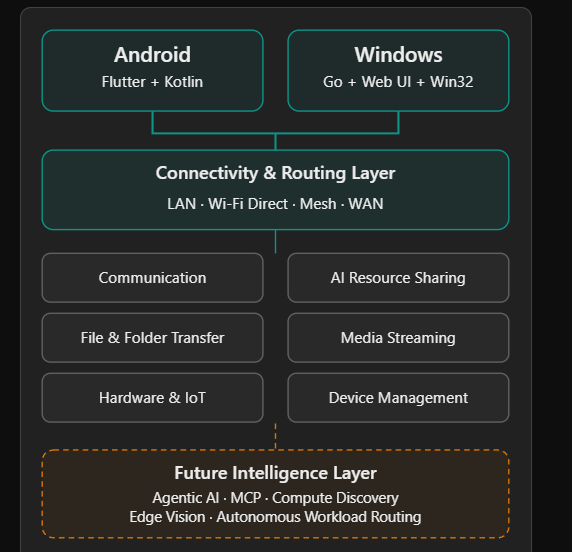
7. NearMitra’s Multi-Layer Connectivity Architecture
NearMitra is designed around several networking approaches that address different connectivity environments.
7.1 Local Area Network Communication
Local Area Network connectivity allows devices within an accessible network to discover and communicate with one another.
LAN communication provides a practical foundation for household, office, educational, and laboratory environments.
Common applications include transferring files between Android and Windows, accessing an AI host, sending messages, and establishing supported media sessions.
A local network may remain operational even when its internet connection is unavailable.
This makes LAN-based communication valuable in environments where internet connectivity is limited, expensive, or unreliable.
7.2 Wi-Fi Direct and Peer-to-Peer Connectivity
Wi-Fi Direct enables compatible devices to establish certain wireless connections without depending on a conventional wireless access point.
NearMitra incorporates Android-specific native networking integration through Kotlin to support relevant peer-to-peer operations.
This is an example of how cross-platform frameworks can be combined with native operating system capabilities.
Flutter provides the application experience, while platform-specific APIs handle operations that require deeper access to the operating system’s networking services.
Hardware support, permissions, operating system behavior, and network compatibility influence the availability of individual direct-connectivity workflows.
7.3 Mesh Networking and Multi-Hop Communication
Mesh networking introduces the possibility of forwarding information through intermediate participants.
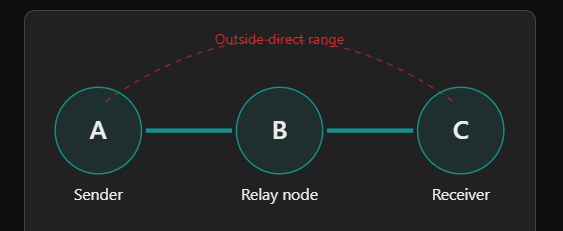
In a conventional direct communication scenario, Device A must reach Device C directly.
A multi-hop architecture can instead allow a compatible Device B to participate in relaying supported messages between them.
NearMitra’s documented message-relay architecture explores this concept through mechanisms intended to control forwarding and prevent repeated packet circulation.
Potential applications include communication across larger local environments, experimental community networks, and environments where direct connectivity is restricted.
Nevertheless, message relaying does not automatically imply that every NearMitra capability operates through arbitrary mesh routes.
High-bandwidth media, file transfers, and AI inference may have different connection requirements.
7.4 Optional Internet and WAN Connectivity
Although NearMitra prioritizes local connections, it also supports optional internet-based discovery and communication mechanisms.
Firebase Realtime Database and WebRTC form part of the documented remote-connectivity approach.
This allows NearMitra to explore communication between devices beyond the immediate local network.
The relevant internet infrastructure must be configured appropriately, and remote connectivity depends on available internet access, signaling, network traversal, and feature compatibility.
NearMitra should therefore be understood as a hybrid connectivity platform with local-first priorities rather than an exclusively offline application.
For technical details, refer to the NearMitra Main README.
8. Wireless File and Folder Sharing Between Android and Windows
File sharing remains one of the most practical applications of cross-device connectivity.
Users frequently need to transfer documents, photographs, videos, application packages, project files, and complete folders between mobile and desktop environments.
Cloud-based file transfers may require internet access, upload and download operations, additional storage, and account management.
NearMitra offers local file transfer functionality within its broader communication environment.
The design incorporates device-oriented conversations, where exchanged files and messages are associated with the relevant participant.
Transfer feedback helps users understand the progress of ongoing operations.
This approach is useful for developers transferring Android builds, students exchanging educational material, photographers moving media, and office users sharing documents.
Folder transfer functionality also makes it possible to exchange organized collections rather than treating every individual file as a separate manual operation.
Actual transfer speeds are influenced by wireless signal quality, network congestion, storage performance, operating system behavior, and hardware capabilities.
NearMitra does not require users to rely on theoretical speed guarantees. Its practical value lies in integrating local file mobility with other cross-device capabilities.
9. Offline Messaging and Device Communication
NearMitra integrates messaging into its device connectivity architecture.
This allows users to communicate between available devices without requiring an internet connection for supported local interactions.
The messaging experience includes conversation-oriented information exchange, message organization, replies, reactions, and attachment-related workflows.
This can be useful in educational settings, shared workspaces, testing environments, and locations where internet availability is inconsistent.
Offline messaging in this context refers to communication over an available local or supported peer-to-peer connection.
It does not mean that messages can travel between completely disconnected devices without any physical or network communication path.
This distinction is essential when designing and evaluating offline communication systems.
NearMitra’s communication architecture provides a common foundation upon which additional application functionality can be integrated.
10. Real-Time Communication with WebRTC
WebRTC is a collection of technologies designed to support real-time audio, video, and data communication between compatible endpoints.
NearMitra uses WebRTC within its real-time communication architecture.
Real-time media introduces requirements that differ considerably from conventional messaging and file exchange.
For example, a file transfer can often tolerate temporary delays while preserving the complete data. A live voice or video session, however, must continuously balance latency, bandwidth, media quality, and connection stability.
NearMitra incorporates real-time communication capabilities such as voice calls, video calls, and supported screen-sharing workflows.
These capabilities can help connected devices communicate beyond text and file exchange.
WebRTC is particularly valuable in cross-device application development because it provides standardized mechanisms for negotiating media connections and transporting real-time information.
The effectiveness of any WebRTC implementation depends on signaling, ICE negotiation, available network paths, and access to appropriate capture devices.
Developers can learn more through the official WebRTC project.
11. Wi-Fi Audio and Multimedia Resource Sharing
NearMitra’s resource-sharing philosophy also extends to multimedia hardware.
A smartphone is more than a communication interface. It contains microphones, speakers, cameras, and audio-processing capabilities that can be useful within a connected computing environment.
NearMitra’s wireless audio functionality explores the use of these resources across devices.
For example, supported Windows playback audio can be transmitted to an Android device through a dedicated wireless audio session.
This allows the smartphone to function as a receiving audio endpoint.
Similarly, microphone and camera-related workflows can make selected mobile hardware capabilities available within authorized NearMitra sessions.
These features illustrate an important conceptual transition: a connected device can become a provider of capabilities rather than merely a recipient of files.
NearMitra does not automatically convert a smartphone microphone into a universal Windows system microphone for every third-party application. Operating-system-wide hardware virtualization would require additional driver and integration infrastructure.
This distinction demonstrates the difference between application-level resource sharing and system-level virtual hardware.
Practical Multimedia Applications
NearMitra’s multimedia capabilities may be useful for personal workspaces, multimedia experiments, remote presentation assistance, educational demonstrations, and users who want to make better use of existing devices.
Its architecture also offers learning opportunities for developers interested in audio capture, stream processing, media-session management, and real-time networking.
12. Camera Streaming and Edge Vision
Connected smartphones frequently contain cameras with capabilities that may exceed those of conventional desktop webcams.
NearMitra provides supported camera-streaming functionality through permission-based interactions.
An authorized receiving device can view a compatible camera stream without requiring the installation of a completely separate camera-sharing ecosystem.
This creates opportunities for educational demonstrations, local monitoring experiments, remote visual assistance, and connected-device workflows.
The long-term potential becomes more interesting when camera streams are combined with local AI inference.
Future development could explore computer vision applications such as object detection, occupancy analysis, agricultural observation, environmental monitoring, and event-triggered notifications.
For example, a camera-equipped mobile device could capture visual information while a more powerful local computer performs compatible vision inference.
Such an architecture would separate image acquisition from computational analysis.
Advanced autonomous surveillance, production-grade object counting, and intelligent vision automation should be considered development directions rather than guaranteed current NearMitra features.
Any monitoring implementation must additionally account for consent, privacy, network security, and applicable legal requirements.
13. NearMitra’s Flutter Architecture: How the Android Application Is Built
From a Flutter developer’s perspective, NearMitra provides an interesting example of an application that extends considerably beyond traditional user-interface development.
Many Flutter applications primarily interact with REST APIs, databases, and conventional application services.
NearMitra operates within a more complex environment involving persistent connections, peer discovery, asynchronous events, permission management, media streams, background execution, and local hardware capabilities.
These requirements make architectural separation particularly important.
A useful conceptual model for understanding NearMitra’s Android architecture consists of the following layers:
| Architectural Layer | Responsibility |
|---|---|
| Presentation | Screens, conversations, device discovery and user interactions |
| Application coordination | Feature workflows, application state and session coordination |
| Connectivity | Device discovery, connection management and transport selection |
| Protocol handling | Message representation and communication processing |
| Platform integration | Android permissions, native networking and platform services |
| Feature services | AI, file sharing, messaging and multimedia operations |
| Persistence | Local preferences, conversation information and pending operations |
This is a functional representation of the system rather than a claim that the repository follows a specific named architecture or exact package hierarchy.
13.1 Flutter as the Application Experience Layer
Flutter provides the foundation for the Android application’s visual and interactive experience.
Its reactive rendering model is valuable for displaying changing device availability, message state, transfer progress, streaming AI responses, and active multimedia sessions.
A connectivity application must respond continuously to events originating outside the immediate user interface.
For example, an incoming message, a disconnected peer, a new AI response fragment, or a changing file transfer state may arrive independently of user interaction.
Flutter’s asynchronous programming environment allows these events to be incorporated into responsive application experiences.
Learn more about Flutter’s framework architecture through the official Flutter documentation.
13.2 Dart and Asynchronous Networking
Dart provides language-level support for asynchronous operations through futures, streams, and event-driven execution.
These capabilities are highly relevant to networking applications.
A persistent socket connection may continuously receive information. A file transfer may produce progress updates over an extended period. An AI inference operation may generate multiple partial responses before completion.
Treating these workflows as asynchronous processes allows the application to remain interactive while communication occurs.
Dart also provides networking APIs through its standard libraries, enabling developers to implement network clients, socket communication, and structured data processing.
NearMitra demonstrates the importance of combining asynchronous programming with appropriate connection-state management.
For further reading, visit the Dart asynchronous programming documentation.
13.3 Kotlin and Native Android Integration
Cross-platform frameworks cannot independently expose every operating system capability.
Certain Android networking operations, permission flows, background services, and hardware interactions require platform-specific integration.
Kotlin complements NearMitra’s Flutter architecture by providing access to Android capabilities such as supported Wi-Fi Direct operations.
Flutter’s platform-channel mechanism allows Dart code and native Android code to exchange structured requests, results, and events.
This architecture enables developers to maintain a consistent Flutter interface while selectively implementing specialized operations within the native platform environment.
For example, a Flutter interface may initiate a peer-discovery operation, while the corresponding native integration handles operating-system-specific communication with Android’s networking framework.
The result can be communicated back to Flutter for application-level processing and presentation.
See Flutter Platform Channels and the Android Wi-Fi P2P documentation for related engineering concepts.
13.4 Device Discovery and Presence Management
Device discovery is a fundamental requirement for an application that allows users to communicate with nearby peers.
A discovery system must address several questions:
- Which devices are currently reachable?
- How should devices identify themselves?
- How should the application react when a device changes networks?
- When should an unavailable device be considered offline?
- How should repeated discovery information be reconciled?
- How should the system restore connectivity after interrupted network access?
NearMitra uses network discovery mechanisms to establish peer visibility.
Its documented architecture incorporates UDP multicast for relevant local discovery operations and connection-based verification for presence management.
UDP is useful for distributing lightweight discovery information without establishing an individual connection to every potential participant.
However, UDP delivery is not guaranteed. Consequently, presence-management logic must account for missed announcements and temporary network interruptions.
This is why discovery and verified reachability should be treated as separate concepts rather than assuming that a single missed announcement indicates a disconnected device.
13.5 TCP Socket Communication
TCP provides a reliable, ordered byte-stream transport between connected endpoints.
This makes it suitable for many messaging and file-transfer scenarios where data integrity and ordering are important.
NearMitra’s documented networking architecture uses socket-based communication for relevant direct-device operations.
Building an application protocol on TCP introduces additional engineering requirements.
TCP itself does not preserve application-level message boundaries. The application must define how messages are structured, how payload lengths are interpreted, and how incomplete data is handled.
A robust protocol implementation must also account for connection termination, invalid input, interrupted transfers, resource limits, and concurrent communication.
NearMitra offers developers an opportunity to study how a real application combines networking transports with higher-level user-facing features.
13.6 Background Execution and Network Lifecycle
Mobile operating systems impose significant restrictions on applications running in the background.
An application may be suspended, have its processes terminated, lose network access, or encounter manufacturer-specific battery-management behavior.
These conditions create substantial challenges for connectivity applications.
NearMitra incorporates background networking and recovery mechanisms intended to maintain supported communication workflows when the application is not actively displayed.
The design must balance connectivity requirements with battery consumption, operating system policies, user permissions, and foreground-service restrictions.
Reliable background execution cannot be assumed to behave identically across every Android manufacturer and software version.
This makes real-device testing particularly important.
13.7 Architectural Lessons for Flutter Developers
NearMitra illustrates several practical principles for building networking-intensive Flutter applications.
Networking logic benefits from separation from individual screens. Device state should be managed consistently across features. Incoming events require careful subscription and lifecycle management. File transfers and AI generation need cancellation and progress handling. Native integrations should remain clearly bounded by their responsibilities.
These principles help prevent the presentation layer from becoming tightly coupled to low-level communication details.
NearMitra provides an open-source reference through which developers can explore these challenges in a practical context.
14. NearMitra’s Windows Architecture: Why Go Complements Flutter
Although NearMitra’s Android application is built using Flutter and Kotlin, its Windows implementation follows a different architectural approach.
The desktop application uses a Go backend together with an embedded web-based interface and native Windows integrations.
This is an important engineering decision because it demonstrates that cross-platform connectivity does not require every participating device to use an identical application framework.
Instead, interoperability can be established through shared communication behavior.
Flutter is particularly effective for interactive application experiences. Go provides characteristics that are valuable for networking services, concurrent processing, background workers, and executable distribution.
Combining these technologies allows platform implementations to address different requirements while remaining part of the same ecosystem.
14.1 Go as a Networking and Coordination Layer
Go is widely used in network services and concurrent applications.
Its goroutines, channels, networking libraries, and straightforward deployment model make it relevant to software that must coordinate multiple simultaneous operations.
In a desktop connectivity environment, such operations may include maintaining peer information, handling incoming connections, responding to communication requests, updating transfer state, and coordinating active services.
NearMitra’s Windows architecture illustrates how a Go-based application can support connectivity and background operations while presenting an accessible desktop interface.
Developers can explore Go’s networking and concurrency capabilities through the official Go documentation.
14.2 Embedded Web Interface and Desktop Integration
NearMitra’s Windows interface combines HTML, CSS, and JavaScript with a desktop-oriented application launcher.
This hybrid approach separates interactive presentation from backend networking operations.
Native Windows integration provides access to selected operating system features, including system-tray behavior, file-management integration, application startup, and audio-related operations.
The architecture demonstrates that modern desktop applications can combine web technologies with native services without requiring a purely browser-hosted cloud application.
14.3 Cross-Language Interoperability
Perhaps the most educational aspect of NearMitra’s architecture is the interaction between different programming ecosystems.
The Android application utilizes Dart and Kotlin. The desktop implementation uses Go and web technologies.
For these applications to communicate successfully, their internal programming languages are less important than their agreement on communication protocols.
Consistent interpretation of message types, device identities, payload structure, feature requests, error states, and session behavior becomes essential.
This principle is widely applicable to distributed systems, IoT platforms, microservices, and cross-platform networking products.
NearMitra therefore offers a useful study of protocol-oriented interoperability beyond a single-framework application.
Read the dedicated NearMitra Windows README for platform-specific documentation.
15. Hardware Integration, IoT and Capability Sharing
One of the more distinctive directions explored by NearMitra is the integration of connected hardware resources.
Internet of Things systems frequently consist of sensors, controllers, electronic devices, gateways, and applications that collect or process information.
NearMitra’s broader resource-sharing architecture provides a foundation for exploring interactions between conventional computing devices and compatible hardware gateways.
Documented integration directions include relay controllers, environmental sensors, weighing equipment, NFC devices, and authorized mobile-device information.
These integrations depend on compatible interfaces and appropriate hardware configuration.
They should not be interpreted as universal plug-and-play compatibility with every available IoT device.
15.1 Smart Environments and Industrial Applications
A connected environment may contain physical equipment that produces measurements or responds to control requests.
Through compatible gateways, application software can potentially collect environmental data, display measurements, and initiate authorized operations.
In a warehouse, for example, digital weighing equipment could provide measurements to a connected application.
In a research environment, sensor gateways could expose environmental readings.
In a smart agricultural environment, compatible soil-monitoring equipment could provide information about field conditions.
These examples illustrate potential application scenarios rather than independently validated production deployments.
Safety-critical equipment must additionally implement appropriate electrical protection, authentication, hardware-level safeguards, and reliable failure-handling mechanisms.
15.2 Connecting Hardware with Artificial Intelligence
The combination of hardware connectivity and local AI opens further research opportunities.
A future intelligent application could collect approved sensor information, interpret its meaning through a suitable model, and provide recommendations to the user.
This could establish a layered architecture involving data acquisition, connectivity, intelligence, and controlled execution.
Such workflows would be particularly relevant to edge computing and IoT research.
However, connecting an AI model to physical equipment requires strict authorization boundaries. An AI-generated instruction must not automatically become an unrestricted physical action.
Human oversight and hardware safety mechanisms remain essential.
Refer to the NearMitra Hardware and IoT Integration Guide for documented integration requirements and limitations.
16. NearMitra vs LocalSend: Understanding the Real Differences
LocalSend is an established open-source application that provides cross-platform local-network file and message sharing.
It is particularly useful for users who want a straightforward way to exchange information between different operating systems without relying on external file-transfer servers.
LocalSend and NearMitra share certain technological interests, including Flutter development, local networking, open-source accessibility, and direct device communication.
However, their broader product objectives differ.
LocalSend focuses primarily on making local information exchange accessible across a wide range of platforms.
NearMitra explores a broader device connectivity environment in which information exchange is one component alongside AI sharing, real-time communication, multimedia sessions, and hardware integration.
Detailed NearMitra and LocalSend Comparison
| Feature or Architectural Area | NearMitra | LocalSend |
|---|---|---|
| Primary focus | Cross-device connectivity and resource sharing | Nearby file and message exchange |
| Open source | Yes | Yes |
| Android support | Yes | Yes |
| Windows support | Yes | Yes |
| iOS support | Future direction | Yes |
| macOS support | Future direction | Yes |
| Linux support | Future direction | Yes |
| Flutter application | Android application | Cross-platform application |
| Desktop architecture | Go and embedded web technologies on Windows | Flutter-based application architecture |
| Local file sharing | Available | Available |
| Internet-free local transfers | Supported | Supported |
| Text communication | Conversation-oriented messaging | Local message sharing |
| Local AI engine sharing | Available through supported integrations | Not a documented core feature |
| Ollama integration | Available on configured hosts | Not a documented core feature |
| Voice and video communication | Supported workflows | Not a documented core feature |
| Camera streaming | Supported workflows | Not a documented core feature |
| Dedicated wireless audio | Supported workflows | Not a documented core feature |
| Optional remote connectivity | Available with configuration | Primarily local-network oriented |
| IoT integration | Documented compatible gateway integrations | Not a documented core feature |
| Transport architecture | Multiple networking mechanisms | REST API and HTTPS-oriented communication |
| Encryption | Varies by communication path; universal E2EE not established | HTTPS-based encrypted communication |
| Agentic AI | Proposed roadmap | Not a documented core feature |
| Software license | GPL-3.0-only | Apache-2.0 |
16.1 A Difference in Product Philosophy
The most meaningful distinction is not simply the number of available features.
It is the role that device connectivity plays within each product.
LocalSend treats connectivity primarily as a means of exchanging files and messages conveniently.
NearMitra treats connectivity as a foundation upon which different device capabilities can be accessed and shared.
These approaches serve overlapping but distinct requirements.
16.2 LocalSend’s Strengths
LocalSend offers broad operating system coverage, a focused application experience, a well-established local transfer protocol, and a substantial open-source ecosystem.
Its emphasis on straightforward information exchange makes it particularly attractive to users who do not require additional communication or AI functionality.
Its HTTPS-based architecture also provides an important security reference for developers building local-network applications.
NearMitra’s broader feature scope should not be interpreted as evidence that it provides better transfer speeds, stronger security, or greater reliability than LocalSend. Such conclusions would require controlled comparative testing.
16.3 NearMitra’s Distinctive Direction
NearMitra becomes particularly relevant when users require more than file exchange.
A developer may want to access a desktop-hosted AI engine from a smartphone. A user may want to exchange files while maintaining a device conversation. A researcher may want to experiment with local AI and connected hardware. A workspace may benefit from integrating communication and selected resource-sharing capabilities.
These scenarios reflect NearMitra’s broader technological direction.
Rather than describing NearMitra as a replacement for every local file-sharing application, it is more accurate to describe it as an alternative approach to cross-device connectivity.
Both projects demonstrate valuable applications of open-source development and modern networking technologies.
Learn more about LocalSend through its official website and GitHub repository.
17. Who Is NearMitra Designed For?
NearMitra addresses several categories of users with different technological requirements.
Software Developers and Flutter Engineers
NearMitra provides a practical codebase for studying peer-to-peer connectivity, asynchronous programming, socket communication, native Android integration, media streaming, and cross-language interoperability.
Developers can explore real architectural challenges that extend beyond conventional API-driven mobile applications.
Artificial Intelligence Enthusiasts
Users experimenting with local AI models can explore ways to make their configured inference engines accessible from additional devices.
NearMitra AI is particularly relevant for individuals interested in personal AI infrastructure and reducing unnecessary duplication of model installations.
Students and Educational Institutions
Students can use supported connectivity features to exchange educational material, collaborate within local environments, and experiment with AI access.
Computer laboratories may also explore approved shared inference resources for learning purposes.
Offices and Small Organizations
NearMitra can provide a connected environment for exchanging documents, communicating between devices, and accessing selected shared capabilities.
Organizations evaluating deployment should independently assess security, administration, compatibility, and operational requirements.
Researchers and Technology Innovators
Researchers interested in distributed intelligence, edge computing, local networking, and heterogeneous computing environments can explore NearMitra’s architectural direction.
Its open-source nature makes it possible to inspect implementations, identify limitations, and experiment with extensions.
IoT and Embedded Systems Developers
Hardware developers can investigate how compatible sensor interfaces and gateways can participate in broader connected-device workflows.
This may lead to experimental applications involving sensor collection, local dashboards, AI-assisted interpretation, and supervised control.
Users in Low-Connectivity Environments
Supported local workflows may be useful in environments where internet access is intermittent or limited.
NearMitra does not eliminate the requirement for a communication network, but it can reduce reliance on internet infrastructure for compatible operations.
Privacy-Conscious Technology Users
Individuals interested in operating AI models and communication resources within their own environment may find NearMitra’s local-first philosophy valuable.
Privacy-sensitive deployments must still evaluate the security properties of each communication path independently.
18. Agentic AI and MCP: NearMitra’s Future Intelligence Layer
Artificial intelligence is gradually evolving from systems that primarily generate responses toward systems capable of planning and performing controlled actions.
This development is commonly associated with AI agents and agentic AI architectures.
NearMitra’s long-term direction explores how intelligent agents could interact with connected devices and their authorized capabilities.
An AI agent might eventually identify a relevant resource, request access to an appropriate tool, coordinate an operation, and present the result to the user.
Model Context Protocol, commonly known as MCP, represents an important development in connecting compatible AI applications with external tools and information resources.
NearMitra’s proposed MCP direction could provide opportunities to expose selected device capabilities through structured interfaces.
18.1 From Conversational AI to Action-Oriented Intelligence
The present Nearby AI experience primarily involves submitting requests to a configured AI engine and receiving generated responses.
An action-oriented system introduces additional layers.
These could include task interpretation, tool discovery, authorization, controlled execution, result verification, cancellation, and execution history.
For example, a user might request that an AI assistant analyze a sensor reading or prepare a document for transfer to another device.
A future execution layer could determine which approved resource is required.
The fundamental objective would be to enable intelligent coordination without granting unrestricted access to connected devices.
18.2 Permission-Based Agent Architecture
An agent operating across multiple devices introduces significant security and governance requirements.
Before carrying out actions, a responsible system should determine which device is being accessed, what operation is requested, whether the user has approved it, and whether the operation falls within the authorized scope.
Additional safeguards would include permission revocation, action previews, audit records, execution limits, and reliable cancellation mechanisms.
This is particularly important when AI agents interact with files, cameras, microphones, sensors, or physical equipment.
18.3 Future Intelligent Resource Discovery
A more advanced connectivity environment could allow devices to advertise information about their available resources.
Such information might include supported AI models, available memory, processing capacity, media capabilities, and accessible tools.
A future orchestration system could use this information to identify suitable resources for a particular task.
This would move NearMitra closer to the concept of an intelligent, heterogeneous computing environment.
Automatic model routing, resource scheduling, general agent execution, and MCP-based orchestration remain proposed development areas.
They should not be confused with functionality already available in the current application.
Visit the NearMitra Official Website to explore its documented roadmap. Additional information about MCP is available through the official Model Context Protocol documentation.
19. Security, Privacy and Responsible Device Connectivity
Connecting devices introduces responsibilities that extend beyond functionality.
A platform that exchanges information, exposes AI engines, or enables access to hardware must consider the security implications of each operation.
NearMitra’s permission-based approach establishes an important principle: access to a device should not automatically imply access to every capability available on that device.
AI resources, multimedia streams, sensors, and hardware interfaces require appropriate access boundaries.
Local-first architecture can reduce unnecessary interactions with external infrastructure. Nevertheless, an untrusted participant on a local network may still represent a security risk.
Therefore, local connectivity should not be treated as a substitute for secure protocol design.
Important engineering considerations include:
- Reliable peer identification and authentication
- Feature-specific authorization
- Appropriate transport encryption
- Safe handling of incoming requests
- Protection of AI prompts and generated information
- File-transfer validation
- Resource consumption limits
- Secure network configuration
- Permission revocation
- Responsible hardware integration
- Software-update integrity
NearMitra remains an actively developing open-source project. Universal end-to-end encryption across all communication paths has not been established, and the documented Windows installer has not yet been digitally signed.
Users evaluating NearMitra for sensitive organizational or production environments should review its security characteristics, deployment requirements, and current limitations.
These considerations are part of responsible software engineering and should remain visible throughout the development of connected intelligence systems.
20. NearMitra as an Open-Source Learning Resource
Open-source software provides value beyond the functionality of distributed applications.
It allows developers to study architectural decisions, understand implementation trade-offs, investigate issues, and contribute improvements.
NearMitra is relevant to developers interested in several advanced technology areas.
These include Flutter networking, native Android integration, local AI, WebRTC, TCP and UDP communication, background services, multimedia engineering, desktop development with Go, hardware integration, and distributed application design.
Many educational examples demonstrate these technologies independently.
NearMitra offers an opportunity to investigate how they interact within a larger application environment.
A developer exploring NearMitra may discover challenges involving synchronization, connection recovery, cross-platform state management, permission handling, streaming responses, and operating system integration.
Understanding these challenges can provide valuable experience for building communication-intensive and resource-sharing applications.
The project is distributed under the GPL-3.0-only license.
Developers who modify, redistribute, or build derivative software should understand the obligations associated with this license.
Explore the project through FlutterFever Studio and its public GitHub repository.
21. Getting Started with NearMitra
Getting started with NearMitra involves installing compatible applications, establishing a connection, and exploring the available features.
Step 1: Download NearMitra
Visit the official GitHub release page and select the appropriate application for Android or Windows.
Step 2: Establish Network Connectivity
For an initial test, connect both devices to the same accessible local network.
Ensure that operating system permissions, network isolation settings, and firewall configuration allow the required communication.
Step 3: Discover and Connect Devices
Launch NearMitra on both devices and use the available discovery or pairing functionality.
Select the appropriate peer before initiating a communication workflow.
Step 4: Explore File Sharing and Communication
Begin with a simple message or file transfer.
This provides a useful initial verification that device discovery and basic transport operations are functioning.
Additional capabilities can then be tested according to their specific requirements.
Step 5: Configure Nearby AI
To explore NearMitra AI, configure a supported local AI engine on the host computer.
Install an appropriate Ollama model, establish the required AI configuration, and authorize the requesting device.
The connected client can then interact with the configured engine through the supported Nearby AI interface.
Step 6: Explore Multimedia and Connected Resources
After establishing basic connectivity, users may explore supported multimedia sessions and compatible hardware integrations.
Always review the relevant permissions and platform-specific limitations.
Developers who prefer building from source can follow the instructions in the Main README and the Windows README.
22. Present Capabilities and Future Development
NearMitra combines available application capabilities with an ambitious long-term development direction.
Understanding the distinction between these categories is essential.
| Technology Area | Development Status |
|---|---|
| Android and Windows connectivity | Available |
| Local file and folder transfer | Available |
| Device-oriented messaging | Available |
| Shared AI inference | Available through supported configurations |
| Real-time communication | Supported workflows |
| Wireless audio and camera streaming | Supported workflows |
| Message relay architecture | Documented implementation |
| Optional WAN connectivity | Requires configuration |
| Hardware and IoT gateways | Documented integrations; hardware validation required |
| Advanced AI vision | Future development |
| Automatic compute discovery and routing | Proposed roadmap |
| General-purpose agent execution | Proposed roadmap |
| MCP-based device orchestration | Proposed roadmap |
| Additional operating system support | Future direction |
| Universal encrypted communication | Further development and verification required |
This distinction reflects an open-source engineering philosophy in which current implementations establish the foundation for future experimentation.
NearMitra already provides meaningful connectivity and AI-sharing capabilities, while more advanced distributed intelligence requires continued development, testing, and community participation.
23. The Broader Vision: From Connected Devices to Connected Intelligence
The evolution of computing has repeatedly demonstrated the value of connecting previously isolated resources.
Networks transformed independent computers into collaborative systems.
The internet connected information across geographic boundaries.
Cloud computing made large-scale infrastructure accessible through remote services.
Artificial intelligence now introduces a new question: how can intelligent capabilities become accessible across the devices and environments people already own?
NearMitra explores this question from a local-first perspective.
The smartphone, desktop computer, camera, sensor, and AI host can potentially participate in a shared technological environment where each contributes selected capabilities.
A smartphone may provide a convenient interface and multimedia hardware.
A desktop computer may contribute storage and AI inference.
A compatible gateway may expose sensor information.
A communication layer may coordinate the exchange of information between these participants.
Future intelligent orchestration could make the relationships between these resources more dynamic.
The ultimate opportunity is not merely to create another application with numerous features.
It is to investigate how existing computing resources can be connected more meaningfully, reducing unnecessary duplication and enabling intelligent collaboration.
NearMitra represents FlutterFever’s exploration of this direction through open-source development, practical connectivity features, and an evolving vision for shared intelligence.
24. Frequently Asked Questions About NearMitra AI
What is NearMitra AI?
NearMitra AI refers to the artificial intelligence sharing capabilities within NearMitra, an open-source local-first connectivity platform designed for Android and Windows devices.
It enables authorized clients to interact with compatible AI engines hosted by connected devices.
Is NearMitra free and open source?
Yes. NearMitra is available as a free, open-source project under the GPL-3.0-only license.
Its source code and application releases are accessible through GitHub.
Can NearMitra work without the internet?
Yes. Supported local communication, file-transfer, and locally hosted AI workflows can operate without internet access when the devices have an appropriate communication path.
Internet-based connectivity and cloud-dependent AI services require internet access.
Can I use Ollama on Android through NearMitra?
Yes. Through a supported connection and approved configuration, an Android device can interact with an Ollama engine running on a compatible computer.
This does not require the Android device to execute the same model locally.
Does NearMitra run its own AI model?
NearMitra primarily provides connectivity and interaction capabilities for configured AI engines.
The AI model and inference runtime are separate components of the architecture.
Is NearMitra an alternative to LocalSend?
NearMitra can serve as an alternative for certain Android-to-Windows local transfer workflows.
However, it has a broader resource-sharing vision, whereas LocalSend offers wider platform coverage and focuses on local file and message exchange.
Is NearMitra built entirely with Flutter?
No. The Android application uses Flutter and Kotlin. The Windows application combines Go, embedded web technologies, and native operating system integration.
Does NearMitra support Wi-Fi Direct?
NearMitra incorporates supported Wi-Fi Direct and peer-to-peer connectivity mechanisms. Availability depends on device compatibility, permissions, and operating system behavior.
Can NearMitra transfer files between Android and Windows?
Yes. Cross-device file and folder sharing is one of its supported core capabilities.
Can NearMitra turn a smartphone into a wireless speaker?
Supported wireless audio workflows allow an Android phone to receive audio from a compatible Windows host.
Does NearMitra support IoT devices?
NearMitra documents integration mechanisms for selected compatible hardware gateways and supported devices.
Actual deployment requires appropriate hardware interfaces, configuration, and validation.
Does NearMitra support AI agents and MCP?
General-purpose agent execution and MCP-based orchestration are part of NearMitra’s proposed future development direction.
They are not currently established production features.
Is NearMitra completely encrypted?
Universal end-to-end encryption across every supported communication path has not been established.
Users should evaluate the relevant security requirements before using the platform for sensitive operations.
Where can I download the NearMitra source code?
The source code is publicly available at github.com/coderbaba0/nearmitra.
Is NearMitra useful for learning Flutter networking?
Yes. NearMitra provides a practical reference for studying asynchronous communication, socket networking, native platform integration, device discovery, state coordination, multimedia workflows, and local AI connectivity.
Conclusion
NearMitra represents an evolving approach to local-first connectivity and cross-device intelligence.
By combining device communication, wireless file sharing, artificial intelligence accessibility, multimedia streaming, and compatible hardware integration, NearMitra explores opportunities that extend beyond conventional connectivity applications.
Its Android architecture demonstrates how Flutter can be combined with Dart networking and Kotlin-based platform integrations. Its Windows architecture illustrates how Go, web technologies, and native operating system services can participate in a common communication ecosystem.
NearMitra AI further introduces a practical approach to making locally hosted artificial intelligence accessible from other authorized devices without requiring each device to execute its own copy of a large model.
For users, NearMitra offers a growing collection of interconnected capabilities.
For developers, it provides an open-source environment for understanding advanced networking and application architecture.
For researchers and technology innovators, it presents opportunities to explore distributed intelligence, edge computing, hardware interoperability, and future agentic systems.
Although important development challenges remain, NearMitra establishes a foundation for investigating a computing environment in which devices can share not only data but also selected resources, capabilities, and intelligence.
At FlutterFever, NearMitra reflects a broader commitment to exploring open-source technology, practical software engineering, and emerging intelligent computing architectures.
NearMitra — Connect Devices. Share Resources. Empower Intelligence.
Explore NearMitra and Contribute
Discover the application, explore its architecture, report issues, experiment with new capabilities, and participate in its open-source development.
Official website:
https://coderbaba0.github.io/nearmitra/
FlutterFever Studio:
Explore the NearMitra Open-Source Application
GitHub source code:
https://github.com/coderbaba0/nearmitra
Download Android and Windows applications:
https://github.com/coderbaba0/nearmitra/releases
Technical documentation:
Main README | Windows Architecture | Hardware and IoT Integration
Developed and published by FlutterFever.
Open Source. Local First. Connected Intelligence.