

Building the Future of Local AI: Extending NearMitra with MCP, NVIDIA, Hardware Sharing, Computer Vision and IoT
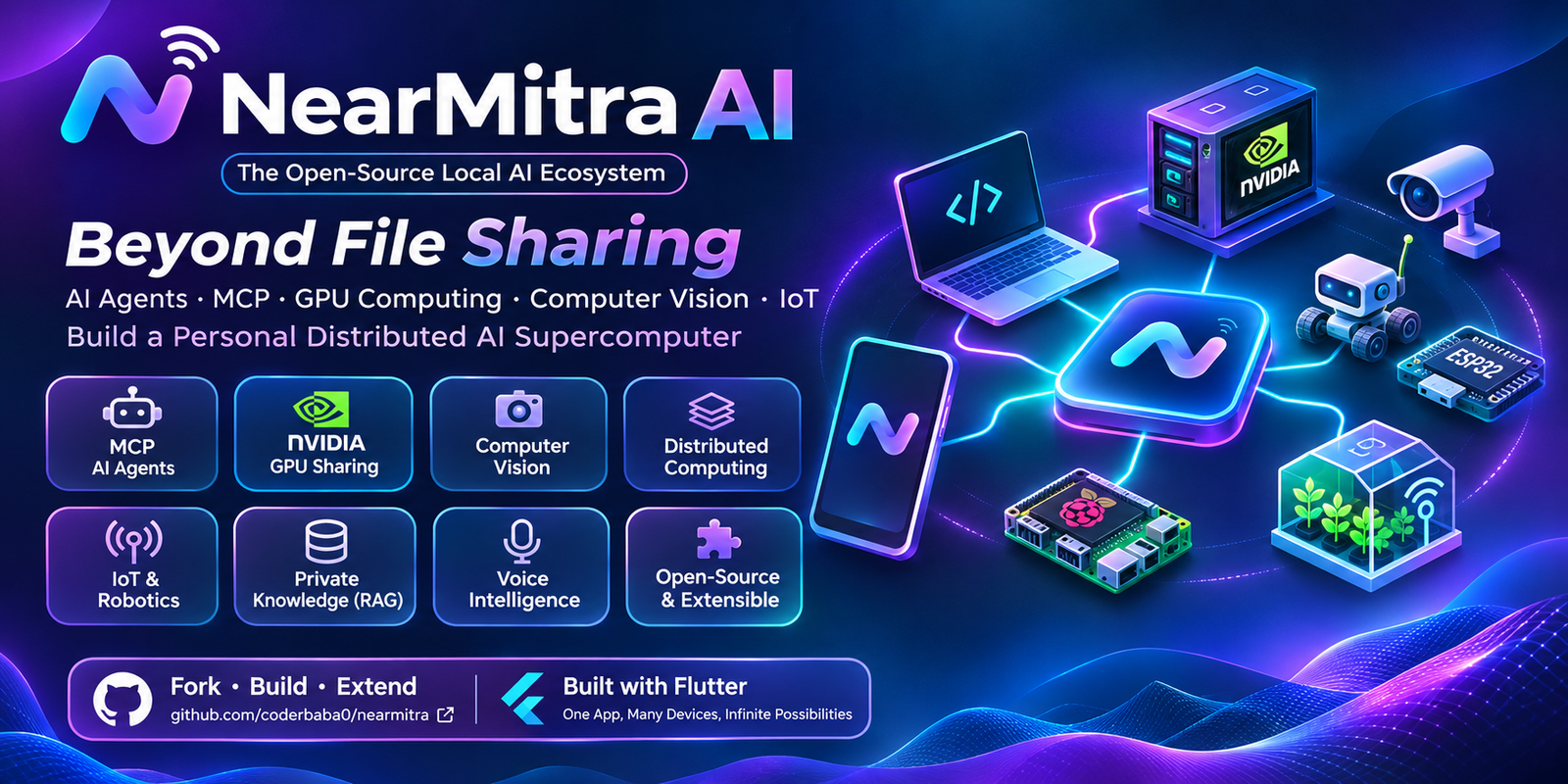
An open-source engineering roadmap for Flutter developers, AI researchers, systems engineers and technology enthusiasts interested in building the next generation of connected intelligence.
What if a smartphone could use the computational capabilities of a nearby NVIDIA-powered workstation, access knowledge stored on a personal computer, interact with intelligent IoT devices, and coordinate physical hardware through a locally hosted artificial intelligence agent?
What if developers could build these capabilities without creating an entire networking and device-connectivity infrastructure from scratch?
NearMitra AI provides an existing open-source foundation for exploring such possibilities. Its documented architecture combines Flutter, Dart, Kotlin, Go, local networking, peer-to-peer communication, multimedia streaming and access to configured AI inference engines.
However, the opportunities extend significantly beyond its present functionality.
This article proposes six independent engineering projects through which open-source contributors can extend NearMitra into a more capable local intelligence ecosystem.
These projects include Model Context Protocol integration, distributed hardware resource sharing, NVIDIA GPU acceleration, computer vision, Internet of Things integration and private retrieval-augmented generation.
Rather than presenting these capabilities as completed features, this article provides architectural guidance, implementation strategies, research references and suggested development milestones for contributors who wish to fork, experiment with and extend the project.
1. Why NearMitra Provides an Interesting Foundation for Open-Source Research
Developing a cross-device artificial intelligence application from scratch requires solving several unrelated but interconnected engineering problems.
Before an application can share intelligence or hardware resources, it must establish communication between devices.
It must understand how devices are discovered, how connections are established, how requests are transmitted, how responses are associated with individual sessions and how users control access to their resources.
Once these foundational requirements are addressed, developers can begin exploring more advanced computing architectures.
NearMitra already documents several relevant capabilities:
- Android and Windows device connectivity.
- Local network device discovery.
- Supported peer-to-peer communication.
- Wireless file and folder sharing.
- Local messaging.
- Access to configured AI inference engines.
- Streaming AI responses.
- Voice and video communication.
- Camera and audio-streaming capabilities.
- Native Android integration and desktop networking services.
These existing capabilities provide a starting point for experimentation.
A developer interested in computer vision may investigate the existing camera-streaming workflow instead of independently building an entire Android-to-Windows connectivity system.
An AI developer may extend the existing Nearby AI workflow with structured tool execution.
An IoT developer may introduce a new category of discoverable devices.
A systems engineer may experiment with task scheduling and hardware capability discovery.
The underlying opportunity is composability: allowing independently developed features to become part of a larger connected computing environment.
2. The Architectural Shift: From Device Discovery to Capability Discovery
Most connectivity applications identify devices by their name, address and connection status.
However, an intelligent computing environment needs to understand more than whether a particular device exists.
It needs to understand what that device can contribute.
A Windows workstation may provide language-model inference, image processing and storage.
An Android smartphone may provide a camera, microphone, GPS information and an interaction interface.
A Raspberry Pi may provide sensor integration and local automation.
An NVIDIA Jetson device may provide specialized computer-vision inference.
An ESP32 may expose environmental sensor readings or control selected physical equipment.
This creates the possibility of a capability-oriented architecture.
Instead of treating the network as a collection of computers, NearMitra could represent it as a collection of authorized computational and physical capabilities.
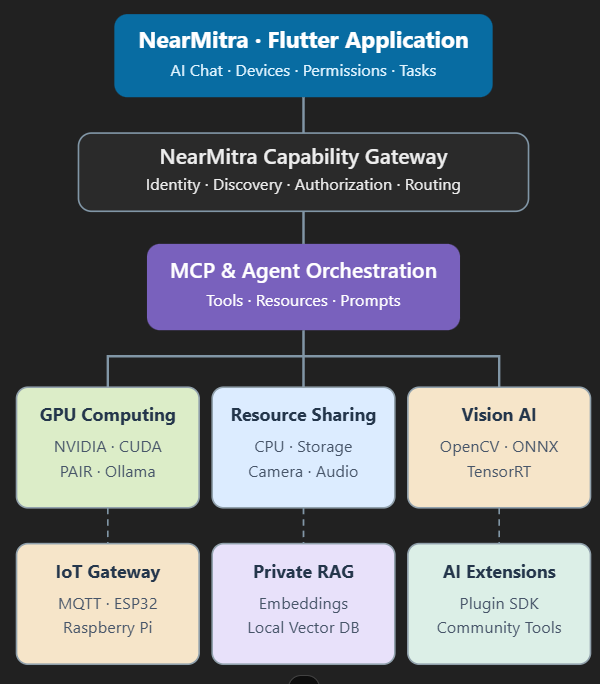
2.1 Introducing a NearMitra Capability Registry
A capability registry could provide a common representation of available device resources.
An illustrative capability manifest might look like this:
{
  "protocolVersion": "1.0",
  "deviceId": "workstation-01",
  "deviceType": "windows-desktop",
  "capabilities": [
    "ai.inference",
    "vision.object_detection",
    "compute.image_processing",
    "storage.shared_documents"
  ],
  "resources": {
    "gpu": {
      "vendor": "NVIDIA",
      "vramMB": 12288
    },
    "memoryMB": 32768
  },
  "authorizationRequired": true
}
This is a proposed application-level schema, not the current NearMitra protocol.
The manifest would allow connected devices to understand which operations may be available without automatically granting access to those operations.
2.2 Capability Discovery and Authorization
Capability discovery must remain separate from authorization.
Advertising that a computer supports AI inference does not mean every device on the network should be permitted to consume its computational resources.
Similarly, advertising camera availability must not automatically enable camera access.
A proposed capability architecture should distinguish:
- Availability.
- Compatibility.
- Device identity.
- Authorization.
- Current resource capacity.
- Session ownership.
- Resource consumption limits.
Sensitive hardware information should only be shared with appropriately authorized peers.
This capability registry could become the foundation for every extension discussed in the following sections.
Project 01: Integrating Model Context Protocol (MCP) into NearMitra
3. From AI Conversations to Permission-Controlled AI Actions
NearMitra’s existing Nearby AI functionality enables a connected device to interact with a configured AI inference engine.
However, generating conversational responses is fundamentally different from interacting with external resources.
A language model may explain how to summarize a document, but it cannot automatically locate, read and process that document unless the surrounding application provides suitable tools.
A model may describe how to interact with an IoT sensor, but it cannot retrieve live sensor readings without an appropriate integration.
Model Context Protocol provides a standardized approach through which AI applications can interact with external tools and contextual resources.
For NearMitra, MCP represents an opportunity to transform local AI accessibility into a permission-controlled tool ecosystem.
3.1 Understanding the Three Components of MCP
MCP integration involves three important architectural roles.
| Component | Responsibility |
|---|---|
| MCP Host | AI application that manages model interaction, permissions and client connections |
| MCP Client | Protocol component that communicates with an MCP server |
| MCP Server | Exposes supported tools, resources and prompts |
NearMitra could participate in this architecture in multiple ways.
It could host an AI interaction environment containing MCP clients.
It could expose selected device capabilities through an MCP server.
It could also provide both roles through independently designed components.
The language model, MCP protocol and tool-execution service should remain logically separate.
3.2 Approach A: NearMitra as an MCP Host
Under this approach, a NearMitra AI session could discover tools from configured MCP servers.
For example, the Windows application could maintain MCP clients for:
- A filesystem server.
- A local knowledge server.
- An IoT data server.
- A computer-vision server.
- A device-monitoring server.
- A developer-tools server.
An Android user could interact with an AI model through NearMitra while the Windows host coordinates approved tool requests.
The execution sequence could follow this pattern:
Flutter AI interface → NearMitra host → AI model → Tool request → Permission validation → MCP client → MCP server → Tool result → AI model → User response
The host would remain responsible for evaluating tool requests before execution.
MCP should not be treated as an unrestricted command-execution interface.
Official resources:
- NearMitra Official Website
- Explore NearMitra on FlutterFever Studio
- GitHub Source Code
- Download Android and Windows Applications
3.3 Approach B: NearMitra as an MCP Server
NearMitra could also expose selected device capabilities to external MCP-compatible applications.
This would allow compatible AI hosts to request approved operations through NearMitra.
Potential tools might include:
| Proposed Tool | Purpose |
|---|---|
list_authorized_devices | Retrieve approved connected devices |
get_device_capabilities | Inspect permitted device capabilities |
get_system_metrics | Retrieve authorized CPU, GPU and memory information |
search_shared_documents | Search explicitly shared content |
request_camera_snapshot | Request a user-approved image |
get_sensor_reading | Retrieve an IoT sensor measurement |
submit_compute_job | Submit a supported computational task |
request_file_transfer | Initiate an approved transfer |
These names are illustrative. Contributors would need to define their own schemas and application contracts.
This approach could make NearMitra a bridge between existing AI ecosystems and local physical devices.
3.4 Designing the First MCP Tool
The first contribution does not need to implement a fully autonomous agent.
A read-only device-status tool would make an excellent initial project.
An illustrative tool definition could be:
{
  "name": "get_device_status",
  "description": "Returns permitted status information for an authorized device.",
  "inputSchema": {
    "type": "object",
    "properties": {
      "deviceId": {
        "type": "string"
      }
    },
    "required": ["deviceId"],
    "additionalProperties": false
  }
}
The corresponding server implementation would:
- Validate the requesting session.
- Verify the target device identity.
- Check the device-status permission.
- Retrieve approved information.
- Return a structured result.
- Record an appropriate audit event.
This limited implementation would allow contributors to validate the complete MCP lifecycle before introducing tools that modify files or control hardware.
3.5 Choosing the MCP Transport
MCP supports standardized transports, including stdio and Streamable HTTP.
A desktop-based architecture could initially launch an MCP server as a separate local process and communicate through stdio.
This simplifies early experimentation because the server does not need to be directly exposed to other devices on the network.
For independently hosted MCP services, Streamable HTTP may provide a suitable transport when implemented with appropriate authentication and transport security.
NearMitra’s existing networking protocol could act as an application-specific bridge between Android and the desktop MCP host.
However, that internal bridge should not be described as a standardized MCP transport unless it satisfies the corresponding protocol requirements.
3.6 How Flutter Can Support MCP Integration
Flutter could provide the user-facing control environment for MCP interactions.
A dedicated MCP dashboard might include:
- Connected MCP servers.
- Available tool descriptions.
- Device-specific permission scopes.
- Pending action requests.
- Tool execution progress.
- Execution history.
- Session cancellation.
- Resource-access controls.
Dart’s asynchronous architecture can support streaming updates while a tool operation is executing.
The Windows host could use a Go-based MCP client or server implementation, while Flutter communicates with the desktop service through a secured application protocol.
This separation avoids requiring the entire MCP ecosystem to execute directly on Android.
3.7 Example: An AI-Assisted Research Workflow
Consider a student using a smartphone to review research material stored on a personal computer.
The student asks NearMitra:
“Find the documents I shared about renewable energy and summarize their main findings.”
A future implementation could allow the AI host to invoke an approved document-search tool.
The tool would return relevant information only from authorized folders.
The AI model could then generate a structured summary using that retrieved context.
If the student subsequently asks to transfer the original document to the phone, NearMitra could request permission before initiating the transfer.
This would combine existing connectivity foundations with proposed MCP and document-retrieval functionality.
3.8 Security Requirements
MCP integration creates a new security boundary.
Tool execution must remain under application and user control.
A model-generated tool request is not equivalent to user authorization.
Contributors should implement:
- Explicit tool allowlists.
- Per-device permissions.
- Input-schema validation.
- Resource limits and timeouts.
- Restricted filesystem access.
- Tool-result size limits.
- Cancellation mechanisms.
- Audit logging.
- Confirmation for sensitive operations.
- Protection against prompt injection through documents and external tool responses.
Network-based MCP services should follow the applicable MCP authorization specification.
The initial implementation should avoid unrestricted shell execution, arbitrary filesystem access and automatically authorized hardware control.
Suggested minimum viable contribution
Create a local MCP server exposing three read-only device-information tools, connect it to a compatible AI host, and implement a Flutter interface for reviewing available tools and approval status.
Useful development resources
- MCP specification: https://modelcontextprotocol.io/
- Official Go MCP SDK: https://github.com/modelcontextprotocol/go-sdk
- Official Python MCP SDK: https://github.com/modelcontextprotocol/python-sdk
- Ollama documentation: https://docs.ollama.com/
Project 02: Distributed Hardware and Resource Sharing
4. Making Device Capabilities Available Across a Local Network
Modern personal computing environments contain substantial hardware resources that frequently remain underutilized.
A workstation may contain a powerful GPU while a smartphone struggles with a computationally intensive workload.
A desktop computer may provide terabytes of storage while a mobile device has limited space.
A smartphone may have an excellent camera while a nearby computer lacks suitable visual input hardware.
NearMitra could evolve toward a resource-sharing architecture in which authorized devices request specific services from compatible peers.
The practical starting point is service-oriented resource sharing rather than transparent hardware virtualization.
4.1 Different Categories of Hardware Sharing
| Resource | Proposed Sharing Mechanism |
|---|---|
| CPU | Remote task execution |
| GPU | AI inference and computational services |
| Storage | Authorized file and document services |
| Camera | Image capture and streaming |
| Microphone | Approved audio input streams |
| Speaker | Network audio playback |
| Sensors | Structured sensor-data services |
| Printer | Permission-controlled print jobs |
Each resource requires a different technical integration.
A camera produces a continuous data stream.
A CPU executes computational tasks.
A storage service manages persistent information.
These resources should not be forced into one universal transport mechanism.
4.2 Introducing a Remote Compute Job System
A remote compute service could allow NearMitra users to request supported processing operations from another device.
A proposed request might look like this:
{
  "jobId": "job-1001",
  "taskType": "image.resize",
  "targetDevice": "workstation-01",
  "parameters": {
    "width": 1920,
    "height": 1080
  },
  "inputReference": "authorized-file-248",
  "timeoutSeconds": 60
}
The receiving device would validate the job, check permission, verify available resources and execute a predefined operation.
Possible initial workloads include:
- Image resizing and conversion.
- Video transcoding.
- PDF rendering.
- Audio conversion.
- File compression.
- Optical character recognition.
- AI inference.
- Batch image processing.
The host should expose predefined task types rather than allowing arbitrary commands.
4.3 Managing Job Lifecycles
A distributed task requires a clearly defined lifecycle.
A job could move through the following states:
Submitted → Authorized → Queued → Running → Completed
Alternative terminal states would include Failed, Cancelled and Expired.
The Flutter application could display active tasks, estimated progress, resource consumption and available output.
A Go-based service could manage bounded worker queues, cancellation contexts, execution deadlines and result storage.
For operations that may be retried, the protocol should define idempotency behavior to prevent accidental duplicate execution.
4.4 Hardware Sharing Is Not Hardware Virtualization
Using a remote GPU for image processing is different from making that GPU appear as a locally installed graphics card.
Similarly, receiving camera frames from a smartphone is different from installing a native virtual webcam driver that exposes those frames to every Windows application.
Virtual hardware requires additional platform-specific infrastructure, potentially involving:
- Virtual camera devices.
- Audio drivers.
- Operating-system service integration.
- Driver signing.
- Network block-storage protocols.
- Specialized virtualization technologies.
These are valuable research opportunities, but they should remain separate from the initial application-level resource-sharing implementation.
4.5 Practical Use Cases
A photographer could submit a collection of mobile images to a desktop for processing.
A student could convert large educational videos using an available workstation.
A developer could perform selected local computational tasks through a mobile interface.
A family could access permitted documents stored on a shared home computer without copying every document onto each device.
In each case, the application would make use of an existing specialized resource through an authorized service.
Suggested minimum viable contribution
Implement a Windows-side compute worker that supports image conversion and resizing, together with a Flutter job-submission interface, progress notifications and result download.
Useful development resources
- Go concurrency: https://go.dev/doc/effective_go
- Dart concurrency: https://dart.dev/language/concurrency
- FFmpeg: https://ffmpeg.org/
- gRPC: https://grpc.io/
- Protocol Buffers: https://protobuf.dev/
Project 03: NVIDIA GPU Integration and Intelligent AI Routing
5. Can Nearby Computers Become Personal AI Infrastructure?
AI workloads can require significantly more computational resources than conventional mobile applications.
Personal computers equipped with compatible NVIDIA GPUs can provide useful inference capabilities for language models, image-processing models, speech systems and computer-vision applications.
NearMitra already provides a documented foundation for accessing a configured AI engine running on another device.
The next research opportunity is to make that access hardware-aware, workload-aware and capable of selecting among multiple authorized inference resources.
5.1 GPU Capability Monitoring
A NearMitra extension could expose approved GPU status information from participating desktop computers.
Potential metrics include:
- GPU vendor and model.
- Total and available VRAM.
- GPU utilization.
- Temperature.
- Active inference services.
- Available AI models.
- Current request queue.
- Supported compute workloads.
For NVIDIA hardware, NVML provides an interface for retrieving supported management and monitoring information.
A Go service could integrate compatible GPU-monitoring libraries or use a dedicated native helper.
Flutter could provide a resource dashboard without directly accessing NVIDIA-specific hardware APIs from the Android device.
5.2 Integrating NVIDIA Personal AI Router
NVIDIA Personal AI Router provides an especially relevant architectural reference.
It enables compatible machines on a local network to participate in an inference-routing environment.
NearMitra could experiment with integrating the local endpoint exposed by PAIR rather than independently implementing every routing capability.
A conceptual integration could be:
NearMitra Android → NearMitra Windows Host → NVIDIA PAIR endpoint → Eligible AI Node → Inference Engine
This would allow the NearMitra desktop service to act as a controlled intermediary between mobile users and a configured inference environment.
PAIR compatibility, supported request formats, authentication requirements and host configuration would need to be verified during development.
The integration should preserve the existing NearMitra user-permission model.
Importantly, this approach distributes independent inference requests. It does not combine GPU memory across computers or divide one model across multiple machines.
5.3 Developing an Independent NearMitra AI Scheduler
Contributors interested in distributed-systems research could alternatively experiment with a lightweight scheduler.
A scheduler might evaluate:
| Selection Metric | Purpose |
|---|---|
| Model availability | Verify the requested model exists |
| Device authorization | Exclude unauthorized hosts |
| Network latency | Estimate communication overhead |
| Available memory | Assess resource constraints |
| Queue length | Estimate waiting time |
| GPU utilization | Consider current computational demand |
| Historical response time | Improve future scheduling decisions |
The first implementation could use a deterministic selection rule, such as choosing the eligible host with the fewest queued requests.
More advanced scheduling could consider expected completion time and workload characteristics.
A request already producing output should not automatically be restarted elsewhere without considering duplicate processing, response consistency and user expectations.
5.4 TensorRT and Specialized Inference Services
NVIDIA TensorRT and TensorRT for RTX provide opportunities for optimizing compatible inference workloads on supported hardware.
Contributors could develop specialized services for:
- Object detection.
- Image classification.
- Speech processing.
- Image segmentation.
- Optical character recognition.
- Supported transformer-based inference.
Rather than embedding every GPU runtime directly into NearMitra, a separate inference service could expose an application-compatible API.
NearMitra would remain responsible for connectivity, authorization, request submission and result presentation.
This modular approach also allows alternative CPU, AMD, Intel or other accelerator backends to be introduced independently.
5.5 Distributed Model Inference as an Advanced Research Project
Running one AI model across several machines is substantially more complex than distributing independent requests.
A distributed model may require continuous exchange of intermediate activations and synchronization between computational stages.
Ordinary wireless networking can introduce a significant bottleneck.
Research contributors could investigate specialized distributed inference implementations, but they should first establish controlled benchmarks.
The relevant question is not simply whether multiple machines can participate.
It is whether the arrangement improves usable model capacity, performance, energy consumption or cost compared with executing the model on a single suitable host.
5.6 Measuring GPU Integration Performance
A serious research contribution should report measurable results.
Useful evaluation metrics include:
- Time to first generated token.
- Output tokens per second.
- End-to-end request latency.
- Peak GPU memory usage.
- Queue waiting time.
- Concurrent request throughput.
- Network traffic.
- CPU and GPU energy consumption, where measurable.
Measurements should compare a single inference host with multiple eligible hosts using equivalent workloads.
No performance improvements should be claimed without reproducible testing.
Suggested minimum viable contribution
Develop a read-only NVIDIA GPU dashboard and an optional PAIR-compatible inference-provider adapter. Demonstrate AI access through the adapter using the NearMitra Android interface.
Useful development resources
- NVIDIA Personal AI Router: https://docs.nvidia.com/local-ai/nvpair/
- PAIR source code: https://github.com/NVIDIA/Personal-AI-Router
- NVIDIA CUDA: https://developer.nvidia.com/cuda-zone
- NVIDIA NVML: https://developer.nvidia.com/management-library-nvml
- TensorRT: https://developer.nvidia.com/tensorrt
- TensorRT for RTX: https://docs.nvidia.com/deeplearning/tensorrt-rtx/latest/
- llama.cpp: https://github.com/ggml-org/llama.cpp
- ONNX Runtime: https://onnxruntime.ai/
Project 04: Edge AI and Computer Vision Using Connected Cameras
6. Transforming Camera Streaming into Visual Intelligence
A smartphone camera captures considerably more information than ordinary user interfaces can represent.
Computer vision provides mechanisms for extracting useful structured information from images and video streams.
NearMitra documents supported camera-streaming workflows, which create an interesting foundation for developing cross-device vision applications.
Instead of requiring a smartphone to execute every vision model locally, an authorized computer could process selected frames.
This could allow mobile devices to benefit from more capable desktop inference hardware.
6.1 Proposed Vision Architecture
A connected vision pipeline could contain the following stages:
Android Camera → Native Capture Service → Frame Selection → Secured Media Transport → Desktop Vision Engine → Structured Detection Results → Flutter Interface
The smartphone would capture the visual information.
The desktop could perform model inference.
The Flutter application could display detection results, bounding boxes, confidence values or relevant notifications.
6.2 Why Full-Resolution Video Is Not Always Necessary
Sending every camera frame at its original resolution can introduce substantial network and processing overhead.
An uncompressed 1920 × 1080 RGB frame contains approximately 6.22 MB of image data.
At 30 frames per second, this corresponds to approximately 187 MB per second before protocol overhead.
Compressed video, frame sampling and appropriately resized images can significantly reduce these requirements.
Many computer-vision applications do not require inference on every captured frame.
For example, an agricultural crop-monitoring workflow may analyze selected images rather than continuously process 30 frames per second.
Contributors should choose a frame-processing strategy according to the actual application requirement.
6.3 Choosing Between On-Device and Host-Side Inference
Flutter-based applications could support multiple vision execution strategies.
| Strategy | Suitable Workload |
|---|---|
| Android-side inference | Lightweight models and privacy-sensitive processing |
| Desktop-side inference | Larger models and GPU-intensive processing |
| Edge device inference | Dedicated camera or sensor installations |
| Hybrid inference | Lightweight local detection followed by detailed remote analysis |
Android integration could use compatible native machine-learning runtimes.
Windows or Linux hosts could use OpenCV, ONNX Runtime, TensorRT or other specialized inference frameworks.
Flutter would provide a consistent interaction environment across supported execution strategies.
6.4 Returning Structured Results Instead of Raw Images
In many applications, the user does not need the processed video stream to be sent back to the phone.
The receiving system could return detection metadata.
An illustrative response might be:
{
  "frameId": "frame-1042",
  "objects": [
    {
      "label": "apple",
      "confidence": 0.94,
      "box": {
        "x": 0.20,
        "y": 0.30,
        "width": 0.25,
        "height": 0.32
      }
    }
  ]
}
Flutter could overlay the normalized coordinates on a corresponding camera preview, accounting for image rotation, cropping and display scaling.
This separation can reduce unnecessary return-stream bandwidth.
Frame identifiers and timestamps would help associate results with their corresponding visual inputs.
6.5 Computer Vision and Multimodal AI
Another research direction involves connecting visual information to compatible multimodal AI models.
A user could capture an image and request an explanation from a model running on an authorized workstation.
Potential applications include:
- Reading supported documents.
- Understanding product labels.
- Image-based educational assistance.
- Object identification.
- Visual inspection.
- Interpreting machinery displays.
- Preliminary agricultural image analysis.
Model outputs must be evaluated according to their reliability.
For agricultural, medical, industrial or other consequential applications, an AI-generated interpretation should not automatically replace qualified human assessment.
6.6 Agricultural and Industrial Opportunities
A particularly interesting application involves smartphones acting as portable visual-data collection devices.
A farmer could capture images of leaves or produce and send them to a configured vision service for preliminary analysis.
A warehouse operator could use a connected camera to investigate inventory-recognition workflows.
An industrial developer could experiment with visual quality inspection using suitable hardware and validated models.
NearMitra could provide the connectivity and interaction infrastructure, while domain-specific contributors develop the corresponding analytical models.
6.7 Combining Vision with MCP
Computer-vision services could also expose approved operations through MCP.
A future AI agent might request:
- User-approved image capture.
- Object-detection processing.
- Retrieval of relevant documentation.
- A structured explanation of the detected objects.
This would combine vision, local inference and knowledge retrieval within one controlled workflow.
Camera access should always remain visible, revocable and subject to the device owner’s permission.
Suggested minimum viable contribution
Create an Android camera snapshot feature connected to a desktop image-analysis service using OpenCV or ONNX Runtime. Return detection metadata and render bounding boxes through Flutter.
Useful development resources
- OpenCV: https://opencv.org/
- ONNX Runtime: https://onnxruntime.ai/
- Google MediaPipe: https://ai.google.dev/edge/mediapipe/solutions/guide
- LiteRT: https://ai.google.dev/edge/litert
- NVIDIA Jetson: https://developer.nvidia.com/embedded-computing
- Android CameraX: https://developer.android.com/media/camera/camerax
- Flutter camera package: https://pub.dev/packages/camera
Project 05: IoT, ESP32, Raspberry Pi and Local Automation
7. Extending NearMitra Beyond Smartphones and Computers
The Internet of Things introduces another category of connected resources.
Temperature sensors, environmental monitoring devices, smart switches, agricultural equipment and embedded controllers can all provide useful information or physical functionality.
Many IoT systems rely on centralized cloud services for monitoring and automation.
NearMitra could explore local alternatives by introducing an extensible IoT gateway.
This would allow compatible embedded devices to participate indirectly in the connected intelligence environment.
7.1 Why an IoT Gateway Is the Practical Starting Point
Small embedded devices such as ESP32 boards do not necessarily need to implement the complete NearMitra communication protocol.
Instead, a gateway could translate between NearMitra’s application environment and established IoT protocols.
A Raspberry Pi, desktop computer or dedicated local server could operate an MQTT broker and an IoT adapter.
A conceptual architecture would be:
ESP32 Sensors → MQTT Broker → NearMitra IoT Gateway → Flutter Dashboard
This approach allows contributors to reuse established IoT communication technologies.
7.2 Designing a Common Sensor Model
Different sensors produce different data structures.
NearMitra could introduce a normalized representation:
{
  "deviceId": "greenhouse-sensor-01",
  "sensorType": "temperature",
  "value": 28.6,
  "unit": "celsius",
  "timestamp": "2026-11-27T06:00:00Z",
  "quality": "valid"
}
The gateway would convert supported device messages into this common representation.
Flutter could then display dashboards, historical trends and alerts without requiring a completely different interface for every sensor manufacturer.
7.3 MQTT Integration
MQTT provides a lightweight publish-subscribe communication model commonly used in IoT environments.
Different devices can publish information to authorized topics, while compatible subscribers receive relevant updates.
Illustrative topics might include:
nearmitra/greenhouse/temperaturenearmitra/greenhouse/humiditynearmitra/field/soil_moisturenearmitra/workshop/air_quality
A local MQTT broker could operate independently of public internet infrastructure.
Authentication, topic-level permissions and secure transport should be considered essential components of the integration.
7.4 Agricultural IoT Applications
Agricultural monitoring offers a useful example of how local AI and connected hardware could complement each other.
An ESP32-based sensor installation could collect:
- Soil-moisture readings.
- Environmental temperature.
- Relative humidity.
- Light intensity.
- Water-level readings.
NearMitra could display these measurements on an Android device.
A configured local AI model could help explain recent trends using sensor measurements and approved contextual information.
For example:
A farmer asks, “Show me how soil moisture has changed during the last 24 hours.”
The AI host invokes a read-only sensor-history tool, receives the relevant data and returns a summary.
Any automated control of irrigation equipment would require separately engineered safeguards, appropriate authorization and reliable fallback behavior.
7.5 AI-Controlled IoT Automation through MCP
MCP could provide a standardized tool interface for accessing the IoT gateway.
Potential tools might include:
| Tool | Operation |
|---|---|
list_sensors | Discover authorized sensors |
get_sensor_value | Retrieve a current reading |
get_sensor_history | Retrieve historical measurements |
get_device_health | Retrieve equipment status |
request_device_action | Request an explicitly permitted operation |
Read-only operations provide a sensible initial development scope.
Physical control operations should require additional safeguards.
An AI model must not become the sole decision-making mechanism for safety-critical systems.
Hard limits, device-level interlocks, manual controls and deterministic safety logic should remain independent of AI-generated instructions.
7.6 Home Assistant and Matter Integration
Contributors could also investigate integrations with existing smart-home technologies.
Rather than creating a new smart-home ecosystem, NearMitra could provide intelligent interaction with existing authorized controllers.
Home Assistant offers a potential integration environment for locally managed devices.
Matter provides another interoperability direction for supported smart-home ecosystems.
These integrations could allow NearMitra developers to focus on connectivity and AI interaction while using existing device-management infrastructure.
Suggested minimum viable contribution
Build an ESP32 temperature and humidity sensor publishing through Mosquitto. Connect a Go-based IoT gateway and display real-time sensor measurements in Flutter. Add one read-only MCP tool for sensor retrieval.
Useful development resources
- MQTT specification: https://mqtt.org/
- Eclipse Mosquitto: https://mosquitto.org/
- ESP-IDF: https://docs.espressif.com/
- Raspberry Pi: https://www.raspberrypi.com/documentation/
- Home Assistant: https://developers.home-assistant.io/
- Matter SDK: https://github.com/project-chip/connectedhomeip
Project 06: Private Document AI and Local Knowledge Sharing
8. Turning Shared Files into an Intelligent Knowledge Environment
NearMitra already documents file-sharing capabilities and access to locally configured AI inference engines.
An interesting extension would connect these two capabilities through retrieval-augmented generation, commonly known as RAG.
Traditional file sharing helps users move documents between devices.
A knowledge-oriented system would help users find information inside those documents without manually opening every file.
RAG provides a mechanism for retrieving relevant information and supplying it to an AI model as contextual input.
8.1 Proposed Local RAG Architecture
A local document-intelligence pipeline could contain:
- User-authorized document selection.
- Text extraction from supported file formats.
- Document segmentation.
- Embedding generation.
- Local vector-database storage.
- Semantic or hybrid retrieval.
- Context construction.
- AI response generation.
- Source-reference presentation.
Each stage could operate on an authorized personal computer.
The Flutter application would provide document management, indexing progress, search interaction and AI conversation capabilities.
8.2 Choosing the Knowledge Storage Layer
Different projects require different storage solutions.
A small personal document collection may benefit from an embedded local database.
A larger collection may require a dedicated vector-search service.
Potential technologies include:
- SQLite with suitable vector-search extensions.
- Qdrant.
- LanceDB.
- FAISS.
- PostgreSQL with pgvector.
Contributors should evaluate retrieval quality, memory consumption, indexing time and deployment complexity.
The database choice should follow the application requirements rather than simply selecting the most popular framework.
8.3 Secure Document Indexing
A local knowledge system should not automatically index every file on a connected computer.
Document access should be explicitly granted.
Each indexed document should retain appropriate access metadata.
If an authorized directory is removed from the knowledge environment, the associated embeddings, extracted text and cached references should also be handled according to the deletion policy.
The retrieval layer must enforce permissions before returning information to the AI model.
Otherwise, a user could indirectly obtain restricted information through semantic search.
8.4 Cross-Device Knowledge Discovery
An advanced implementation could allow different devices to maintain independent authorized knowledge collections.
One computer could maintain software-development documentation.
Another could maintain agricultural records.
A third could contain educational resources.
A NearMitra knowledge gateway could route search requests to selected authorized knowledge providers.
This would represent distributed knowledge retrieval rather than a single centralized database.
Local-first operation could be preserved when embedding generation, storage, retrieval and inference all remain within the approved computing environment.
8.5 MCP-Based Knowledge Resources
MCP could expose selected research documents through tools and resources.
Potential operations include:
- Searching indexed documents.
- Retrieving a specific source passage.
- Listing authorized knowledge collections.
- Obtaining document metadata.
- Requesting an approved file transfer.
This could allow compatible AI hosts to interact with existing NearMitra knowledge collections.
Source references should accompany retrieved information so that users can evaluate the basis of generated answers.
Suggested minimum viable contribution
Create a local RAG service that indexes explicitly selected PDF and text documents, retrieves relevant passages and supplies them to a configured local AI model. Connect the service to NearMitra through a structured API and implement source references in Flutter.
Useful development resources
- Ollama embeddings: https://docs.ollama.com/
- Qdrant: https://qdrant.tech/documentation/
- FAISS: https://github.com/facebookresearch/faiss
- LanceDB: https://lancedb.com/
- Apache Tika: https://tika.apache.org/
- Docling: https://github.com/docling-project/docling
9. Creating a NearMitra Plugin and Extension Ecosystem
The six projects described in this article should not necessarily become tightly coupled components inside the main application.
A modular extension architecture could allow contributors to develop features independently.
For example, a computer-vision developer should not need to modify the entire AI chat implementation.
An IoT contributor should not need to redesign the file-transfer subsystem.
A plugin contract could define how extensions register capabilities, declare dependencies, receive authorized requests and return results.
An illustrative plugin manifest might contain:
{
  "pluginId": "community.vision",
  "version": "0.1.0",
  "apiVersion": "1",
  "displayName": "NearMitra Vision",
  "capabilities": [
    "vision.object_detection"
  ],
  "permissions": [
    "camera.request",
    "compute.vision"
  ],
  "runtime": "external-service"
}
For the initial implementation, externally running services may provide stronger modularity than dynamically loading untrusted executable code inside the mobile application.
A versioned extension protocol could allow Dart, Go, Python, Rust and C++ developers to participate without adopting the same internal programming environment.
Extension installation should involve explicit trust decisions, dependency review and permission declarations.
NearMitra could eventually maintain a community collection of reviewed integrations.
10. How Flutter Helps Bring These Technologies Together
The proposed research projects involve multiple programming languages, hardware platforms and computational environments.
Flutter’s most important contribution is providing a consistent application layer through which users can interact with these heterogeneous technologies.
Flutter does not replace CUDA, TensorRT, MQTT, MCP, OpenCV or specialized AI runtimes.
Instead, it can coordinate access to their functionality.
| Technology | System Responsibility |
|---|---|
| Flutter | User experience, dashboards and session visualization |
| Dart | Asynchronous application logic and network communication |
| Kotlin | Android hardware and operating-system integration |
| Go | Desktop services, protocol handling and job coordination |
| Python | AI experimentation, document processing and vision services |
| CUDA and TensorRT | Supported NVIDIA GPU inference workloads |
| MCP | Standardized AI tool and resource interaction |
| MQTT | Embedded-device communication |
| WebRTC | Real-time multimedia communication |
| SQLite and vector databases | Local application state and knowledge retrieval |
10.1 Reactive Resource Dashboards
Flutter can represent changes in connected-device availability, GPU utilization, sensor readings and job progress through reactive interfaces.
Applications can update relevant components without requiring continuous manual refresh operations.
10.2 Asynchronous Workflow Management
Dart’s Futures and Streams provide mechanisms for handling concurrent network operations and progressive updates.
A user could monitor a file transfer, receive AI-generated text and inspect sensor readings within one application.
CPU-intensive application processing should be profiled and moved to suitable isolates or specialized native services when necessary.
10.3 Native Hardware Integration
Flutter platform channels allow developers to communicate with Kotlin implementations for Android-specific capabilities.
This is particularly relevant for camera access, wireless networking, foreground services, permissions and operating-system lifecycle management.
10.4 Cross-Platform Protocol Independence
NearMitra’s communication contracts could be implemented independently of Flutter.
This would allow other clients, including command-line tools, desktop services and embedded gateways, to participate through documented interfaces.
The resulting architecture would preserve Flutter’s usability advantages without making every component dependent on the framework.
11. A Suggested Open-Source Repository Structure
Contributors could consider organizing future extensions into independent modules.
The following is an illustrative structure, not a description of the existing repository:
nearmitra/
├── apps/
│   ├── android_flutter/
│   └── windows_desktop/
├── protocol/
│   ├── capabilities/
│   ├── messages/
│   └── permissions/
├── extensions/
│   ├── mcp_gateway/
│   ├── compute_worker/
│   ├── nvidia_provider/
│   ├── computer_vision/
│   ├── iot_gateway/
│   └── local_rag/
├── sdk/
│   ├── dart/
│   ├── go/
│   └── python/
├── examples/
├── tests/
├── benchmarks/
└── docs/
This approach would allow contributors to work on individual services while maintaining shared protocol contracts.
Existing repository conventions should take priority over restructuring the project unnecessarily.
12. Security Architecture Must Evolve Before Resource Sharing Expands
Connecting more hardware and intelligence introduces additional security responsibilities.
NearMitra’s existing documentation acknowledges that some local communication paths are not universally end-to-end encrypted.
Before introducing sensitive MCP operations, document retrieval or hardware-control functionality, contributors should address the relevant transport and authorization requirements.
A future security architecture should consider:
- Authenticated device pairing.
- Encrypted sensitive communication paths.
- Capability-specific authorization.
- Session expiration.
- Permission revocation.
- Filesystem isolation.
- Resource consumption limits.
- Secure credential storage.
- Malformed-message protection.
- Audit trails.
- Extension trust management.
The following principles should guide development:
A discoverable device is not automatically trusted.
A trusted device is not automatically authorized for every operation.
An AI-generated request is not automatically an approved action.
A locally running extension is not automatically secure.
These distinctions become increasingly important as the application evolves from communication software into an intelligent resource-access platform.
13. Open-Source Contribution Roadmap
Not every contributor needs to implement an advanced research subsystem.
NearMitra could become an educational environment for developers at different experience levels.
Beginner Contributions
- Improve device-discovery interfaces.
- Create resource-monitoring Flutter widgets.
- Improve documentation.
- Add mock data for proposed device capabilities.
- Create session-status components.
- Write protocol-parser unit tests.
- Improve accessibility and localization.
Intermediate Contributions
- Implement a local MCP server.
- Build an MQTT sensor dashboard.
- Integrate NVIDIA GPU monitoring.
- Create an image-processing worker.
- Develop a local document-search service.
- Add capability-specific permission screens.
- Build a standardized extension manifest.
Advanced Contributions
- Implement an MCP host and tool-orchestration environment.
- Develop workload-aware AI routing.
- Integrate specialized GPU inference services.
- Design a cross-device computer-vision pipeline.
- Implement distributed knowledge retrieval.
- Develop secure extension isolation.
- Research distributed model inference.
- Build reproducible network and AI benchmarks.
Contributors can begin with a well-defined independent problem and gradually expand their involvement.
14. Suggested GitHub Issues for Community Developers
The following proposed issues could help organize community participation.
| Proposed Issue | Difficulty | Suggested Scope |
|---|---|---|
| Capability Registry v1 | Intermediate | Define device capability schemas |
| Secure Capability Authorization | Advanced | Enforce device-specific access |
| MCP Read-Only Server | Intermediate | Expose approved device information |
| Flutter MCP Dashboard | Intermediate | Tool listing and permission interface |
| Remote Image Processing Worker | Intermediate | Submit and retrieve compute jobs |
| NVIDIA GPU Monitor | Intermediate | Display authorized GPU metrics |
| NVIDIA PAIR Provider Adapter | Advanced | Connect compatible inference endpoints |
| Vision Detection Pipeline | Advanced | Camera capture and desktop inference |
| ESP32 MQTT Gateway | Intermediate | Sensor ingestion and normalization |
| Local RAG Service | Advanced | Authorized document retrieval |
| Extension SDK v1 | Advanced | Standardized service contracts |
| Performance Benchmark Suite | Advanced | Measure networking and AI workloads |
| Mock Device Simulator | Beginner to intermediate | Test features without physical hardware |
| Contribution Documentation | Beginner | Setup guides and architecture examples |
These are suggested community issues, not claims that corresponding GitHub issues already exist.
Maintainers could select appropriate tasks, define acceptance criteria and assign labels such as good first issue, help wanted, research, security, flutter, mcp, iot and computer-vision.
15. How to Fork NearMitra and Begin Development
Developers interested in contributing can start by visiting the official NearMitra project resources and locating the source repository.
The recommended workflow is:
- Fork the public repository on GitHub.
- Clone the fork to a local development environment.
- Review the README, license and existing architecture.
- Build the existing Android or Windows application.
- Identify the subsystem relevant to the proposed feature.
- Discuss the implementation approach with maintainers.
- Create a dedicated feature branch.
- Develop the feature with appropriate tests.
- Document dependencies, configuration and limitations.
- Submit a pull request if the contribution is suitable for upstream integration.
A typical Git workflow could be:
git clone YOUR_FORK_URL
cd YOUR_REPOSITORY

git checkout -b feature/mcp-integration
After implementing and testing the change:
git add .
git commit -m "Add experimental MCP device tools"
git push origin feature/mcp-integration
Developers should avoid committing private credentials, model access tokens, device identities or confidential test data.
NearMitra is documented as GPL-3.0-only licensed software. Contributors and developers distributing modified versions should review the repository’s applicable license obligations and verify compatibility with third-party components.
16. Research and Benchmarking Opportunities
The success of an open-source intelligent connectivity platform should be evaluated through measurable outcomes.
Contributors could publish reproducible experiments addressing questions such as:
MCP Research
How much latency does remote tool invocation introduce?
How effectively can permission policies prevent unauthorized operations?
How reliably do selected local models generate valid structured tool requests?
Distributed Computing Research
How effectively can independent compute tasks be assigned to available hosts?
What is the impact of network latency on remote processing?
Under which workloads does remote execution provide a practical advantage?
NVIDIA Research
How does GPU inference perform under concurrent AI workloads?
When does distributing requests across multiple machines improve throughput?
What model sizes and quantization strategies are appropriate for available hardware?
Computer Vision Research
How does camera resolution affect inference accuracy?
How does wireless latency affect detection-result presentation?
How do sampling frequency and compression influence performance?
IoT Research
How reliably can local sensor information be collected without internet connectivity?
How should stale, missing or contradictory measurements be represented?
What safeguards are necessary when connecting AI-generated requests to physical operations?
Local Knowledge Research
How accurately can a local RAG system retrieve relevant information?
How much storage and memory do document indexes require?
How effectively can retrieval permissions protect restricted knowledge collections?
These investigations could lead to technical articles, academic projects, engineering demonstrations and independent community extensions.
Start Building with NearMitra
Official Website: Explore NearMitra AI
Source Code: GitHub — coderbaba0/nearmitra
Create Your Fork: Fork NearMitra
Downloads: Android and Windows Releases
Contribute: NearMitra Contributor Guidelines
Read the Original Architecture Article: NearMitra AI: Open-Source Local AI, P2P File Sharing & Device Connectivity
Explore More: FlutterFever Studio
Published by FlutterFever — Advancing Open-Source Engineering, Flutter, Distributed Computing and Local Artificial Intelligence.
Who Can Contribute to the NearMitra Ecosystem?
The proposed architecture creates opportunities for several developer communities.
Flutter developers can build interfaces for connected intelligence, resource monitoring and device interaction.
Go developers can create efficient network services, compute workers and scheduling mechanisms.
Python developers can experiment with computer vision, MCP servers, local knowledge retrieval and AI inference integrations.
Kotlin developers can extend Android hardware capabilities and improve native service reliability.
Embedded developers can introduce ESP32, Raspberry Pi and sensor integrations.
GPU engineers can research inference optimization and hardware-aware scheduling.
Security researchers can improve pairing, transport protection, capability authorization and extension isolation.
Students and university researchers can use the project as a foundation for exploring distributed systems, edge AI, networking and human-computer interaction.
Documentation contributors can make these technologies more accessible to developers who are new to systems architecture.
The objective is not to require contributors to understand every component.
It is to define clear boundaries that allow specialized knowledge to contribute to a shared ecosystem.
The Larger Vision: Personal Connected Intelligence
Many modern software environments organize functionality around centralized services.
NearMitra offers an opportunity to investigate a different model.
Imagine a computing environment where:
A smartphone provides the interaction interface and camera.
A desktop computer provides language-model inference and document processing.
An NVIDIA-powered workstation provides specialized GPU computation.
A Raspberry Pi provides environmental monitoring and automation.
An ESP32 provides physical sensor information.
A private knowledge service provides authorized contextual information.
An MCP orchestration layer coordinates selected capabilities.
Flutter provides a consistent interface through which these independently operating resources become accessible.
Such an environment would not necessarily eliminate cloud computing. It would give users additional choices about where computation occurs, how information is accessed and which devices participate.
Developing this environment requires careful engineering, security design, hardware compatibility testing and community participation.
NearMitra’s existing connectivity architecture offers a foundation from which interested developers can investigate that possibility.
Suggested Open-Source Contribution Projects
The following ideas could become independent GitHub issues or community research projects.
| Proposed Project | Difficulty | Primary Technology |
|---|---|---|
| Device Capability Registry | Intermediate | Dart, Go |
| MCP Read-Only Device Server | Intermediate | Go, MCP |
| MCP Agent Dashboard | Intermediate | Flutter |
| Permission and Approval Engine | Advanced | Dart, Go, Security |
| Remote Image Processing Worker | Intermediate | Go, Python |
| NVIDIA GPU Resource Monitor | Intermediate | NVML, Go |
| NVIDIA PAIR Integration | Advanced | Inference APIs |
| Distributed AI Scheduler | Advanced | Go, Systems Engineering |
| Android Vision Node | Advanced | Kotlin, Flutter |
| Desktop Vision Inference | Advanced | ONNX, TensorRT |
| MQTT Sensor Gateway | Intermediate | ESP32, MQTT |
| Robotics Telemetry Adapter | Advanced | ROS 2 |
| Local Document Knowledge Engine | Advanced | RAG, Vector Search |
| Offline Voice Assistant | Advanced | Whisper, Local AI |
| Community Extension SDK | Advanced | Protocol Engineering |
| Device Simulator | Beginner to Intermediate | Dart, Testing |
| Performance Benchmark Suite | Advanced | Systems Engineering |
| Architecture Documentation | Beginner | Technical Writing |
Developers can explore current community discussions and existing reports through NearMitra GitHub Issues.
These proposed projects do not imply that matching issues have already been created.
19. How to Fork NearMitra and Implement Your Own Ideas
Begin by visiting the official NearMitra GitHub repository.
Use the Fork Repository option to create your own development copy.
Review the Contribution Guide before choosing a branch or development workflow.
Clone your fork:
git clone https://github.com/YOUR_USERNAME/nearmitra.git

cd nearmitra

git remote add upstream https://github.com/coderbaba0/nearmitra.git

git fetch upstream
For the Flutter application:
flutter pub get
flutter test
flutter run
Check the repository README for SDK requirements and platform configuration.
Windows developers should review the desktop application directory and its build instructions.
Select a focused contribution rather than attempting to implement the entire futuristic architecture at once.
A good initial contribution should include a feature description, architecture explanation, installation instructions, tests, known limitations and security considerations.
When the implementation is ready, open a GitHub Pull Request according to the project’s contribution requirements.
Review the NearMitra GPL-3.0 license and the licenses of any external technologies you integrate.
Frequently Asked Questions
Does NearMitra currently support MCP?
MCP integration is a documented roadmap direction. The architectures and tools discussed in this article are proposed contributions rather than confirmed production features.
Can NearMitra use NVIDIA GPU resources?
NearMitra can access configured AI inference engines on compatible hosts. Dedicated GPU monitoring, NVIDIA PAIR integration and GPU-aware scheduling are proposed extensions.
Can several computers combine their GPUs through NearMitra?
Ordinary remote inference and request routing do not combine GPU memory. Distributed execution of a single model would require specialized infrastructure and substantial additional research.
Can Flutter developers contribute without AI expertise?
Yes. Permission screens, dashboards, session management, resource monitoring, testing and protocol integration provide valuable contribution opportunities.
Can NearMitra connect with ESP32 and Raspberry Pi?
A proposed IoT gateway could integrate these devices through MQTT or other suitable protocols. Contributors would need to implement and test the integration.
Can developers build their own extensions using Python?
Yes, a documented service protocol could allow Python-based services to participate independently of the Flutter application. The proposed extension architecture would support this approach.
Can NearMitra become a private AI document assistant?
A local RAG integration could make this possible. It would require document parsing, embeddings, indexing, authorized retrieval and suitable AI inference components.
Is NearMitra suitable for academic research?
Its combination of networking, Flutter development, local AI and device interaction offers several potential research directions. Existing functionality and experimental extensions should be evaluated independently.
Conclusion: An Invitation to Build Together
Open-source projects become valuable not only because of the features they currently provide, but also because of the possibilities they make available to other developers.
NearMitra AI already explores the relationship between local networking, cross-device communication and artificial intelligence.
Its next phase could involve broader community experimentation with Model Context Protocol, hardware resource sharing, NVIDIA GPU computing, edge vision, IoT and private knowledge environments.
Each proposed extension represents an independent opportunity to solve practical engineering problems.
Developers do not need to build an entire intelligent computing platform from scratch. They can investigate one area, create a focused contribution, publish their findings and share their improvements with the community.
Whether you are a Flutter developer, an AI engineer, an IoT enthusiast, a university researcher or someone interested in distributed computing, NearMitra provides an existing foundation worth exploring.
Fork the project. Study the architecture. Experiment responsibly. Document your results. Contribute improvements.
Together, the open-source community can investigate a future in which devices do more than exchange information.
They can make their intelligence, knowledge and capabilities accessible to one another.
Connect Devices. Share Resources. Extend Intelligence. Build Together.
Explore the NearMitra Open-Source Project
Read the original architecture article to understand the existing application foundation:
NearMitra AI: Open-Source Local AI, P2P File Sharing & Device Connectivity
Explore the source repository and published releases through the official project links.
Additional Flutter Engineering References
- Flutter architecture: https://docs.flutter.dev/resources/architectural-overview
- Flutter platform channels: https://docs.flutter.dev/platform-integration/platform-channels
- Dart isolates: https://docs.flutter.dev/perf/isolates
- Dart networking: https://api.dart.dev/dart-io/
- WebRTC: https://webrtc.org/
Published by FlutterFever — Supporting Open-Source Development, Flutter Engineering, Artificial Intelligence and Connected Computing Research.
Start Building with NearMitra
Official Website: Explore NearMitra AI
Source Code: GitHub — coderbaba0/nearmitra
Create Your Fork: Fork NearMitra
Downloads: Android and Windows Releases
Contribute: NearMitra Contributor Guidelines
Read the Original Architecture Article: NearMitra AI: Open-Source Local AI, P2P File Sharing & Device Connectivity
Explore More: FlutterFever Studio
Published by FlutterFever — Advancing Open-Source Engineering, Flutter, Distributed Computing and Local Artificial Intelligence.